Choosing the right straw for your foodservice business is a surprisingly complex decision. The ongoing debate over paper straws vs metal straws often leaves operators feeling stuck between sustainability goals and operational reality. Making the wrong choice can lead to hidden costs, logistical headaches, customer complaints, and even health and safety liabilities that impact your bottom line. The key is to reframe the question: it’s not about which material is "better," but which solution best fits your business model.
For most high-volume foodservice operations, high-quality paper straws are the better choice over metal straws. This is because paper straws offer predictable costs, eliminate the significant operational burden of cleaning and sanitization, and mitigate major hygiene and safety risks. While metal straws are reusable, their total cost of ownership—factoring in labor, utilities, replacement, and liability—is often far higher[1] and introduces unacceptable risks for a commercial environment.
Now that we’ve established the core operational trade-off, let’s dive into the details. The decision between paper and metal isn’t just about the straw itself; it’s about the entire system you must build around it. We’ll break down the hidden costs, risks, and customer experience factors that don’t always appear on a supplier’s price list.
At first glance, a reusable metal straw seems like a smart long-term investment. You buy it once, and it can be used hundreds of times, right? Unfortunately, this simple math crumbles under the financial pressure of a real foodservice environment. When we talk with procurement managers, their primary focus often shifts from unit price to Total Cost of Ownership (TCO) once they see the full picture.
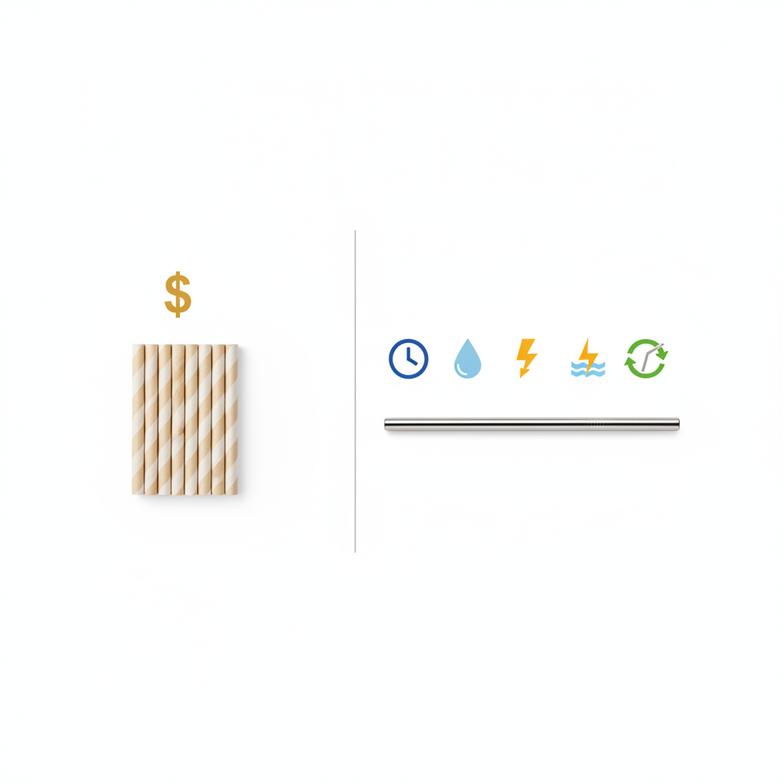
The TCO of metal straws includes the initial purchase price plus ongoing, recurring costs for labor (collecting, washing), utilities (water, energy), specialized cleaning equipment, and high replacement rates. In contrast, paper straws have a straightforward, predictable TCO with zero post-use operational costs, making them easier to budget for and often cheaper overall.
When a potential client approaches us, we encourage them to look beyond the per-unit price tag and model the real-world cost implications. A simple spreadsheet exercise can be incredibly revealing.
The financial model for paper straws is simple. They are a consumable good, treated as part of the cost of goods sold (COGS) for each drink served.
The TCO for metal straws is complex and contains numerous variable costs that can escalate quickly.
1. Collect used straws from tables and bus tubs. 2. Separate them from other waste. 3. Manually scrub the interiors with special brushes. 4. Load them into dishwasher racks (often specialized ones). 5. Run a high-temperature sanitizing cycle. 6. Unload, dry, and restock them for service. This process adds minutes of labor to each straw’s lifecycle, which, when multiplied across hundreds or thousands of drinks per day, becomes a significant payroll expense.
Here’s a simplified table illustrating the cost comparison:
| Cost Factor | High-Quality Paper Straws | Metal Straws |
|---|---|---|
| Upfront Cost | Low per unit | High per unit |
| Labor Cost (Post-Use) | $0.00 | High and Recurring |
| Utility Cost (Water/Energy) | $0.00 | Moderate and Recurring |
| Cleaning Supplies/Equipment | $0.00 | Moderate Initial & Recurring |
| Replacement Cost | N/A (Consumable) | High (due to loss/theft) |
| Total Cost of Ownership | Predictable and often lower | Volatile and often higher |
From a purely financial perspective, the predictable, controlled cost of paper straws presents a much more stable and manageable option for most foodservice businesses.
Beyond cost, every operational decision must be weighed against its potential risks. As a business owner, you are responsible for mitigating risks related to public health, customer safety, and legal compliance. In this context, the choice between disposable paper and reusable metal becomes a critical risk management decision.
Metal straws introduce significant operational risks, including improper sanitation leading to bacterial growth, potential health code violations, and physical safety liabilities. The primary risk of paper straws is entirely quality-related (e.g., sogginess), which can be completely mitigated by partnering with a reputable supplier that provides durable, certified products.

During our consultations, the conversation about paper straws vs metal straws quickly turns to liability. Experienced operators know that even a single negative incident can have devastating consequences for their brand reputation and finances.
This is the single greatest operational challenge. A hollow tube is one of the most difficult items to clean and sanitize effectively in a fast-paced commercial kitchen.
Metal is a rigid, thermally conductive material, which introduces physical risks that simply don’t exist with paper.
The risk profile for paper straws is fundamentally different and far easier to manage.
Ultimately, your business thrives on providing a positive customer experience. Every element, down to the straw, contributes to the overall perception of your brand. A frustrating, inconvenient, or worrying experience can sour a customer’s entire visit and make them less likely to return.
In high-volume, fast-paced environments like quick-service restaurants or coffee shops, customers value the speed, convenience, and guaranteed hygiene of a single-use paper straw. The operational drag and perceived hygiene concerns of metal straws can detract from the customer experience, making paper the superior choice for ensuring seamless service.

From our experience working with diverse foodservice clients, matching the straw to the customer’s expectation is paramount. The debate of paper straws vs metal straws is also a debate about brand positioning and service speed.
In the world of grab-and-go coffee, fast-casual lunches, and stadium concessions, speed is king.
This is a point that cafe and restaurant owners bring up with us constantly. Food safety is not just about what is clean, but what feels clean to the customer.
A fresh paper straw, particularly one dispensed from a sanitary unit or provided in a wrapper, is visibly and undeniably clean.[9] It provides immediate peace of mind. A metal straw, on the other hand, carries a small but significant mental question mark for the customer: “How well was this really cleaned? Who used it before me?” This flicker of doubt is something no brand wants associated with their product.
It’s important to acknowledge that there are scenarios where metal straws can align with a brand identity. A high-end, sit-down cocktail bar or a boutique eco-luxury restaurant might use branded metal straws as part of a curated, premium experience. In this model, the volume is low, the prices are high, and the "ritual" of using and cleaning these items is part of the brand’s story. However, this is a niche application. For the vast majority of foodservice operations, the operational demands far outweigh the branding benefits.
It’s complicated in a commercial context. While metal is durable, the intensive cleaning process requires significant amounts of hot water and energy, and chemical detergents. When you factor in the high replacement rates due to loss and the environmental impact of mining and manufacturing stainless steel, the "greener" choice is not clear-cut. High-quality paper straws from FSC-certified sources are biodegradable and compostable, offering a simpler end-of-life cycle.
Sogginess is a product quality failure, not an inherent flaw of all paper straws. Early-generation and low-quality paper straws created this negative reputation. Modern, premium paper straws, like the 3-ply and 4-ply versions we manufacture, use food-safe adhesives and high-density paper designed to remain rigid and functional for 3-4 hours in a cold beverage[10].
Proper sanitation requires a strict, documented process. This typically involves investing in specialized long-handled brushes, an ultrasonic cleaner to dislodge internal debris, and a commercial high-temperature dishwasher that reaches sanitizing temperatures. Most importantly, it requires rigorous and continuous staff training and supervision, adding a significant management burden to your operation.
Upfront, a single metal straw can cost 50 to 100 times more than a single paper straw. While the idea is to recoup that cost over many uses, the Total Cost of Ownership (TCO) for metal is often much higher. Once you add the recurring daily costs of labor for washing, increased utility bills, and replacing lost straws, the predictable, low-cost model of disposable paper straws is frequently the more economical choice.
When evaluating paper straws vs metal straws for your foodservice operation, the most effective approach is to analyze them as competing operational systems, not just products. The initial question of "which is better?" evolves into "which system poses less risk and offers a more predictable cost structure for my business?" For the vast majority of cafes, restaurants, and foodservice providers, the answer points clearly toward high-quality paper straws. They eliminate the immense labor and liability associated with a reusable sanitation program, offer a guaranteed hygienic experience for customers, and provide a simple, predictable cost model.
While metal straws have a place for personal use, they introduce too many variables—cost, labor, hygiene, and safety—to be a scalable or prudent solution for most commercial operations. By choosing a reliable supplier for durable, certified paper straws, you are making the smarter choice for your customers, your staff, and your bottom line.
If you’re ready to secure a stable supply of durable, food-safe paper straws and leave the operational headaches behind, our team at PaperStrawTech is here to help. Contact us today to discuss your specific needs and receive a custom quote.