
Struggling to pick a custom paper straw? Getting the size or branding wrong can hurt your customer's experience and your brand image.1 Let's fix that.
To choose the right custom paper straw, start with your drink type and cup size, not a generic chart. Then, adapt your branding to the straw's small, curved surface for clear visibility. This ensures a perfect fit for both your drink and your brand identity.
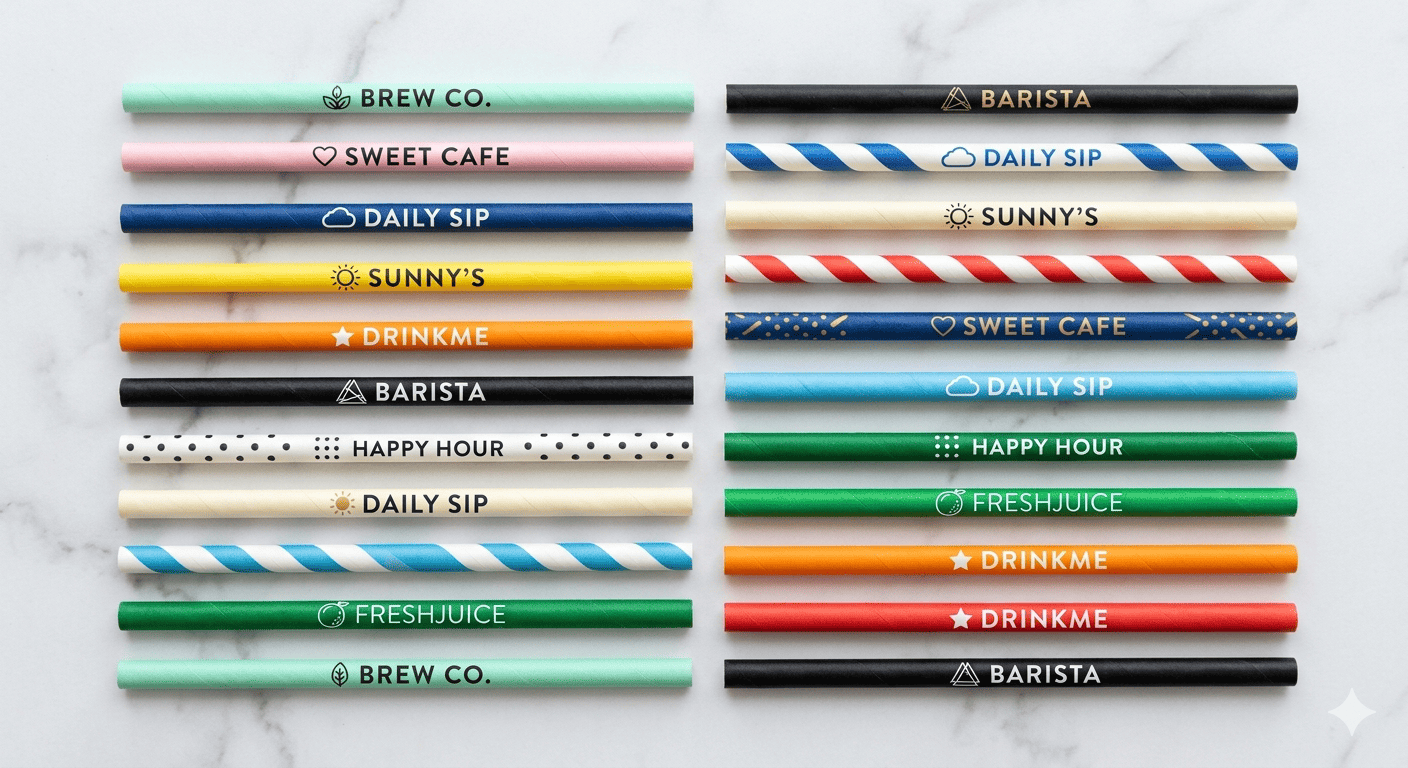
I've handled hundreds of custom orders in my factory, and it's clear that the best results come from a practical, step-by-step process. Many buyers want to talk about design first, but that’s not where we should start. To get it right, we need to think like an engineer and a brand manager at the same time. Let's break down how we guide our partners to choose a custom straw that actually works.
Choosing the wrong straw size is frustrating for customers. A straw that is too short for the cup, too narrow for the drink, or too wide can ruin a perfect experience.2
Match your straw size to the drink's consistency and the cup's height. Use narrow straws (6mm) for thin liquids like juice, medium ones (8mm), and wide ones (12mm) for thick smoothies or bubble tea. Always ensure the length is taller than the cup for easy sipping.
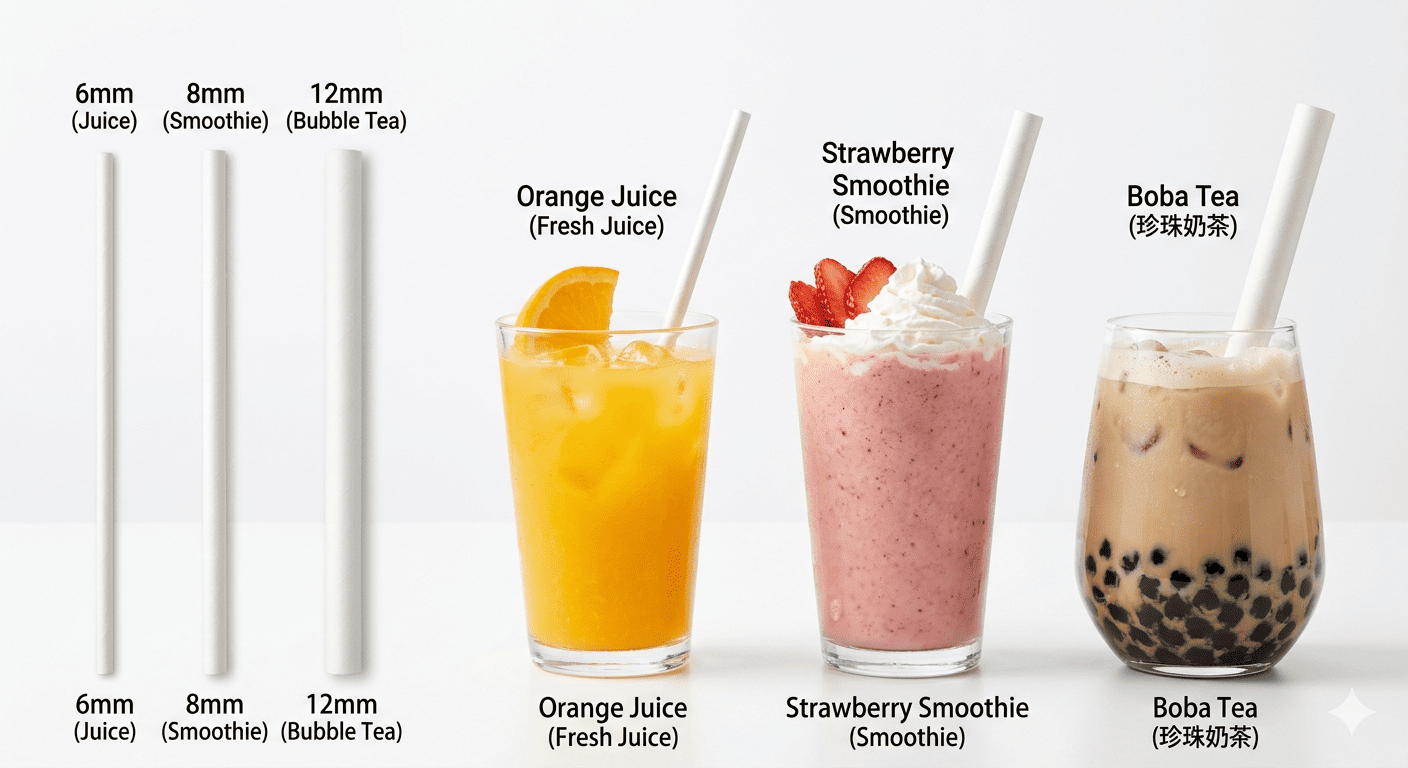
When a new client asks for custom straws, the first question I ask isn't "What color do you want?" It's "What are you serving, and in what kind of cup?" This information is the foundation for everything else. Thinking about the use case first prevents problems later. A straw is a tool, and it has to be the right tool for the job. For example, a thin straw in a thick milkshake will just clog and frustrate the user. A short straw in a tall tumbler will get lost. We need to match the straw's dimensions to its function.
A generic size chart on a website is just a starting point. The real decision comes from understanding the interaction between the drink, the cup, and the customer. In our factory, we use this practical thinking to guide clients.
| Drink Type | Common Diameter Range | Why It Works | Common Scenarios |
|---|---|---|---|
| Water, Juice, Iced Tea | 6mm | The narrow opening allows for easy sipping of thin liquids. It doesn't feel overwhelming. | Standard tumblers, soft drink cups, juice boxes. |
| Sodas, Cocktails | 8mm | A slightly wider diameter is good for carbonated drinks and managing ice cubes. It feels more substantial. | Restaurant glasses, barware, fountain drink cups. |
| Smoothies, Milkshakes | 10mm | A much wider opening is necessary for thicker, blended textures. It prevents clogging and makes drinking easy. | Tall smoothie cups, dessert glasses, blended coffee cups. |
| Bubble Tea (Boba) | 12mm | This is the widest standard option, specifically designed to let large tapioca pearls pass through without getting stuck.3 | Specialty boba tea cups. |
After diameter, length is the next critical factor. The rule is simple: the straw must be taller than the cup. Standard lengths like 197mm (7.75 inches) and 210mm (8.25 inches)4 cover most standard cups, but for extra tall or short cups, we need to customize. I once had a customer who wanted a very long, thin straw for a wide-mouthed jar. On paper, the dimensions worked. But in reality, it looked strange and felt flimsy. We recommended a shorter, wider straw that fit the drink's aesthetic and function much better. Wall thickness, often determined by using 3 or 4 layers of paper, also matters. For hot drinks or situations where the straw will sit in liquid for a long time, a thicker 4-ply straw offers better durability and prevents it from getting soggy too quickly.5
You sent your beautiful logo to a supplier, but the final straws look blurry or distorted. Branding on a tiny, curved, and spiraled surface is tricky and needs a special approach.
To brand a paper straw effectively, simplify your design. Use bold logos, clear patterns, and a limited color palette. Always review a digital mockup and a physical sample before approving a bulk order to ensure your branding is clear and consistent.
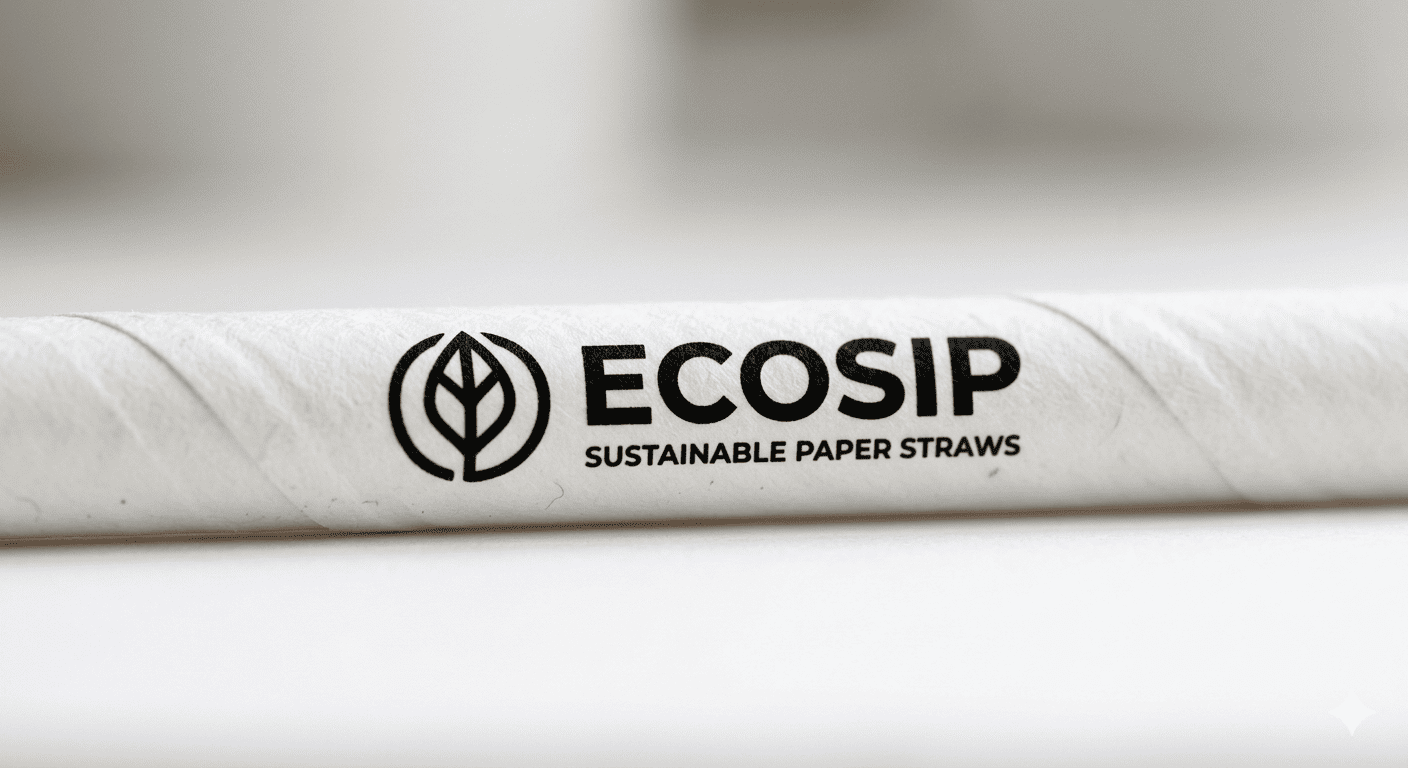
Many people think branding a straw is as simple as sending a logo file. But a paper straw is not a flat business card. The surface is small, curved, and constructed from a spiral-wound piece of paper.6 This creates real-world limits on what we can print effectively. The goal is brand visibility. If nobody can read your logo or recognize your pattern, the customization has failed. A good supplier should work with you to adapt your design for the best possible result, not just promise to print whatever you send.
When we receive a branding request, the first thing my team does is review the design file. We look for potential problems like fine text, complex gradients, or tiny details. These elements often become a blurry mess when printed on a straw. Our job is to be honest about what will work. Often, we suggest simplifying the design. For example, instead of a full company logo with a tagline, we might recommend using just the primary icon or a simplified wordmark. Simple, bold shapes and clean lines always produce the best results. Patterns like stripes, dots, or repeating simple icons are also great options because they are not affected by the spiral seam as much as a complex, centered logo.
Color is another area that requires careful thought. We use food-grade, water-based inks for safety.7 The available color palette for these inks might be slightly different from the CMYK or RGB values in your official brand guidelines. We can get very close, but it’s important to manage expectations. The color of the paper itself also plays a big role. Most straws are made from brown kraft paper or white paper. Printing colors on brown kraft paper will make them appear darker and more muted.8 If you need bright, vibrant, and accurate brand colors, printing on a white paper base is the best choice. This is a conversation we have with every client. For one project, a coffee chain wanted their detailed crest printed on the straws. We created a digital mockup that showed it would be unreadable. We then proposed using just the central shield icon from the crest on a white straw. They approved a sample, and the final product looked sharp, professional, and instantly recognizable.
You found a supplier with a cheap price, but you're worried about hidden problems. Placing a large custom order without checking key details is a huge business risk.
Before ordering, verify more than just the unit price. Request material safety documents (like FDA or LFGB reports9), check the supplier's MOQ and lead time, and most importantly, approve a physical sample. This confirms the print quality, durability, and packaging meet your standards.

The price per straw is just one small part of the total cost. The real cost of a bad custom order is much higher. It includes brand damage from a poorly printed logo, customer complaints from soggy straws, and the potential for failed health inspections if the materials are not certified for your market. As a manufacturer, I believe my responsibility is to help clients avoid these risks. A trustworthy partner will be transparent and provide all the information you need to make a safe and informed decision. The goal isn't just to make one sale; it's to build a long-term relationship based on quality and trust.
A cheap straw that gets soggy in five minutes10 or has a blurry, inconsistent logo is worthless. I always encourage buyers to look at the complete picture. This means asking detailed questions and verifying the answers. A professional supplier will be ready and willing to provide this information. Here is a simple checklist we use to guide our clients.
| Checklist Item | Why It's Important | What to Ask the Supplier |
|---|---|---|
| Material & Ink Docs | This ensures the product is safe for consumers and compliant with your local regulations (e.g., in the US or EU). | "Can you provide current FDA or LFGB test reports for the paper, glue, and ink you will use for my order?" |
| Physical Sample | A digital mockup cannot show you how the straw feels, how the color looks in real life, or how long it lasts in a drink. | "Can I get a pre-production sample made with my exact design and materials before I approve the full order?" |
| MOQ & Lead Time | This affects your inventory planning, cash flow, and ability to meet market demand. | "What is your Minimum Order Quantity (MOQ) for this custom design, and what is the production lead time after I approve the sample?" |
| Packaging Options | How straws are packed (individually wrapped vs. bulk) affects hygiene, presentation, and cost11. | "Do you offer individual paper wrapping? Can the wrapper be branded too? What are the bulk packing options?" |
| Batch Consistency | You need to be sure that the 100,000th straw will look and perform exactly like the first one. | "What quality control processes do you have to ensure color, print, and structural consistency across a large production run?" |
I once had a new customer come to us after a terrible experience with another supplier. They had ordered 500,000 straws, and the colors were inconsistent in every box—some were bright red while others were a faded pink. This happens with poor quality control. We explained our process, which includes using spectrophotometers to match colors12 and performing regular checks throughout the production run. This is the kind of operational detail that separates a reliable supplier from a risky one.
Choosing custom paper straws is about smart, practical decisions. Focus on the drink fit, adapt your branding for clarity, and verify all supplier details to ensure a successful outcome.
"Impact of Pricing and Product Information on Consumer Buying ...", https://pmc.ncbi.nlm.nih.gov/articles/PMC8710754/. A source in marketing or consumer psychology could support the claim by explaining that brand image is built on the sum of all customer interactions, and a failure in a functional detail like a straw can create a negative association. Evidence role: general_support; source type: paper. Supports: The claim that all physical touchpoints, including minor ones like straws, contribute to the overall customer experience and brand perception.. ↩
"FOODAlyzer usability: Advances in food safety education - PMC - NIH", https://pmc.ncbi.nlm.nih.gov/articles/PMC12574919/. A source from product design or consumer research could provide evidence that the functionality and usability of everyday objects, including straws, are key components of a positive user experience. Evidence role: general_support; source type: research. Supports: The claim that a mismatch between a tool (the straw) and the task (drinking a specific beverage from a specific cup) leads to user frustration.. Scope note: The source may discuss general principles of product usability rather than specifically testing beverage straws. ↩
"Bubble tea - Wikipedia", https://en.wikipedia.org/wiki/Bubble_tea. A source discussing the history and cultural practice of bubble tea could confirm that the wide straw was developed or standardized to allow for the consumption of tapioca pearls, a key ingredient of the drink. Evidence role: historical_context; source type: encyclopedia. Supports: The claim that the wide-diameter straw is an integral and standardized piece of equipment for consuming bubble tea.. ↩
"Paper straw size options", https://www.paperstrawgroup.com/paper-straw-size-options/. A source such as a major restaurant or packaging supplier's catalog can confirm that these lengths are offered as standard, off-the-shelf options, indicating they are widely used in the industry to fit common cup sizes. Evidence role: general_support; source type: other. Supports: The claim that 197mm and 210mm are common, standard lengths for straws in the food service industry.. Scope note: A supplier catalog demonstrates commonality rather than an official, codified standard. ↩
"[PDF] Evaluation of Paper Straws versus Plastic Straws - BioResources", https://bioresources.cnr.ncsu.edu/wp-content/uploads/2019/09/BioRes_14_4_8345_Gutierrez_RJVP_Eval_Paper_Plastic_Straws_Props_Testing_Challenges_15725-1.pdf. A study on the material properties of paper straws could provide data showing that 4-ply construction significantly improves resistance to deformation and liquid saturation compared to 3-ply construction. Evidence role: mechanism; source type: paper. Supports: The claim that increasing the number of paper layers (ply) in a straw enhances its structural integrity and slows liquid absorption.. Scope note: The source may provide general principles of laminated paper strength without specifically testing the 3-ply vs. 4-ply straw scenario. ↩
"Spiral Paper Tube Manufacturing Process: Step-by-Step Guide", https://www.jotamachinery.com/academy/spiral-paper-tube-manufacturing-process-step-by-step-guide./. A technical source or video explaining the industrial manufacturing process for paper tubes can illustrate the spiral-winding method and show how the seam it creates can interfere with printed designs. Evidence role: mechanism; source type: education. Supports: The claim that paper straws are manufactured by spirally winding strips of paper to form a tube.. ↩
"Food Packaging & Other Substances that Come in Contact with Food", https://www.fda.gov/food/food-ingredients-packaging/food-packaging-other-substances-come-contact-food-information-consumers. A document from a food safety authority, such as the U.S. Food and Drug Administration (FDA) or the European Food Safety Authority (EFSA), can confirm the regulations governing substances, including printing inks, that are intended to come into contact with food. Evidence role: definition; source type: government. Supports: The claim that inks used on food-contact items like straws must meet specific safety standards.. ↩
"Color Reproduction for Printing | New Mexico State University", https://brand.nmsu.edu/color-reproduction-for-printing/index.html. A source from the printing or graphic design field could explain the principle of subtractive color and how the base color of the paper stock influences the perception of the ink color, often resulting in a darker, more muted tone. Evidence role: mechanism; source type: education. Supports: The claim that printing on a non-white substrate like brown kraft paper alters the final appearance of colors.. ↩
"Food Packaging & Other Substances that Come in Contact with Food", https://www.fda.gov/food/food-ingredients-packaging/food-packaging-other-substances-come-contact-food-information-consumers. An official government source can define the role of the FDA in regulating food-contact substances in the United States, while a source on European regulations can explain that the LFGB is the German law that reflects broader EU standards for food safety. Evidence role: definition; source type: government. Supports: The claim that FDA and LFGB are relevant regulatory frameworks for food-contact materials in the US and EU markets, respectively.. ↩
"Evaluation of paper straws versus plastic straws - BioResources", https://bioresources.cnr.ncsu.edu/resources/evaluation-of-paper-straws-versus-plastic-straws-development-of-a-methodology-for-testing-and-understanding-challenges-for-paper-straws/. A research paper or independent test report could provide data on the liquid-resistance and structural integrity of commercially available paper straws over time, potentially confirming failure within minutes for some products. Evidence role: statistic; source type: research. Supports: The claim that paper straws can fail (become soggy) within a short timeframe of being in a liquid.. Scope note: The exact time to failure will vary based on the specific straw, liquid temperature, and other factors. ↩
"Food Service Guidelines | Nutrition - CDC", https://www.cdc.gov/nutrition/php/food-service-guidelines/index.html. A source from a public health authority or a food safety organization can support this by noting that single-use items should be stored and dispensed in a way that prevents contamination, for which individual wrapping is a common solution. Evidence role: general_support; source type: institution. Supports: The claim that individual wrapping is a recognized method for maintaining the hygiene of straws in a food service environment.. ↩
"What is a Spectrophotometer & Why You Need One For Printing",
. A technical source on color science or manufacturing quality control can explain that a spectrophotometer measures the spectral reflectance of a color, providing precise, objective data that is used to ensure consistency across production batches. Evidence role: definition; source type: education. Supports: The claim that spectrophotometers are a standard tool for objective color measurement in industrial quality control.. ↩