A buyer asks for a price on "8mm x 210mm straws," but a good supplier would slow down before answering. A perfect paper straw sample on your desk does not prove consistency for a bulk order of one million units.
You may have experienced this problem before: a large shipment arrives, but thousands of straws are too short for your cups, too wide for your lids, or have frayed ends that create a poor customer experience.
This issue often starts by focusing on the wrong detail during supplier selection. The real discussion needs to be about acceptable tolerance and process control, not just the target size or the lowest unit price.
Our control of paper straw dimensions comes from a combination of servo-driven machinery, frequent in-process checks using digital calipers, and a final inspection based on agreed-upon tolerances. The final consistency you receive is influenced by the straw’s specific paper layer structure and the clarity of the specification confirmed before production.
As a company involved in both paper straw machinery and the production of finished straws, we see firsthand how process control is the real factor that separates a good sample from a reliable bulk order. The goal isn’t just making one perfect straw; it’s about managing variation from the first straw to the millionth.
We control diameter through precise management of paper tension, glue application, and the winding mandrel, all aimed at staying within an agreed-upon tolerance, such as ±0.3mm.
A common mistake is assuming an "8mm" straw is always the same. In reality, a straw specified as 8mm might measure 7.8mm or 8.2mm. This variation is normal in any manufacturing process. The important question is whether this variation is controlled and suitable for your specific use.
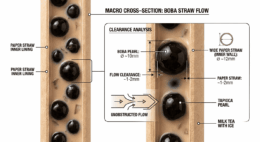
For an iced coffee cup with a standard 8.5mm lid opening, a straw that is consistently 8.2mm might feel loose. For a smoothie, a straw that is consistently 7.7mm might restrict flow. For bubble tea, if the diameter is too small, it won’t pick up the pearls.

Before you place an order, you should ask a potential supplier for their standard manufacturing tolerance for the diameter you need. A reliable supplier should be able to provide this information and explain how it relates to your drink application. You can also ask to see a quality control (QC) report from a previous run to see real-world measurements.
Modern paper straw machines with servo motor-driven cutting systems are key to preventing length variations. Unlike older mechanical controls, servo systems offer more precise and repeatable cutting from start to finish.
If you approve a sample that is exactly 210mm long, you might be surprised if a portion of your bulk order measures 208mm or 212mm. This can happen if the supplier’s machinery has less precise length control. A straw that’s too short can fall into a tall 230mm smoothie cup, while one that’s too long might not fit in your dispenser or takeaway packaging.
We find that length consistency is critical for operational efficiency. That’s why we rely on servo-driven systems. It’s also why our operators perform frequent in-process checks, measuring a sample of straws every 15-30 minutes to ensure the machine is holding the target length.
When evaluating suppliers, ask if their machines use servo motors for length control. Also, ask about their in-process check frequency. A supplier who can clearly explain their process is more likely to deliver a consistent product.
A clean, non-frayed cut is typically achieved with a multi-knife rotary cutting system, especially on thicker-walled straws for smoothies or boba.
A subjective request for a "clean cut" can lead to disputes. A cut that seems acceptable to a supplier might be considered "frayed" by a buyer’s quality team. This is particularly true for straws with more paper layers, like 10mm or 12mm boba straws, which are harder to cut cleanly than a standard 6mm water straw.
A single-blade cutter can crush the straw end slightly before it cuts, leading to a higher chance of fraying. A multi-knife system distributes the cutting pressure, resulting in a smoother finish. This is important for user experience (mouthfeel) and function, as a frayed end can get stuck when piercing the sealing film on a bubble tea cup.
To avoid misunderstandings, I would suggest establishing a clear visual standard. Ask a supplier for magnified photos of the cut ends from a recent production run of a similar straw. This creates a shared, objective reference for what constitutes an acceptable cut before you commit to an order.

You should expect, and agree upon, a specific written tolerance range for both diameter and length. Expecting every single straw in a million-unit order to be identical to a "golden sample" is unrealistic; the goal is consistency within a tolerance that works for your application.
The key is to shift your thinking from "perfection" to "controlled variation." A good supplier works with you to define a specification that meets your functional needs while being achievable in mass production. This table shows how to connect your requirements to the supplier’s process.
| Buyer Requirement | Potential Problem if Uncontrolled | Key Process Control to Ask About | Evidence to Request |
|---|---|---|---|
| Consistent Diameter | Straws don’t fit lid holes, are too loose, or can’t pick up boba pearls. | Paper tension, glue application, and winding mandrel precision. | The supplier’s standard manufacturing tolerance for diameter (e.g., ±0.3mm). |
| Accurate Length | Straws are too short for the cup, too long for packaging, or incompatible with dispensers. | The machine’s length control system. Is it a servo motor or a less precise mechanical setup? | The in-process check frequency for length (e.g., "operator checks 5 straws every 15 mins"). |
| Clean, Smooth Cut | Frayed or crushed ends create a poor user experience and can get stuck in sealed lids. | The type of cutting mechanism used. Is it a single blade or a multi-knife rotary system? | Magnified photos of cut ends from a recent, similar production run. |
| Overall Consistency | A perfect sample is approved, but the bulk order has a high defect rate. | The final sampling and inspection plan before packing (e.g., AQL-based). | A sample Certificate of Analysis (CoA) or QC report showing batch measurements. |
Treat a supplier’s inability to discuss or provide this information as a reason to slow down before ordering. A clear specification sheet with agreed tolerances is your best tool for ensuring the bulk order matches your expectations.
When you compare quotations, it is useful to check if both are based on the same level of dimensional control. A lower price might come from a machine that cannot hold a tight tolerance, leading to more defects.
To help us or any other supplier provide a useful quotation and a product that fits your needs, please prepare the following details before you inquire:
Sending these details allows us to move past a simple price-per-straw conversation and focus on providing a reliable product that functions correctly for your business.