Struggling to make a green claim about your straw wrappers? You're worried about misleading customers. I'll help you understand the real factors behind wrapper recyclability.
Yes, many paper straw wrappers can be recycled, but it's not guaranteed. Recyclability depends on if it's pure paper without plastic coatings1, the type of ink and glue used2, and if your local recycling facility accepts small, thin paper items3. Always check local guidelines first.
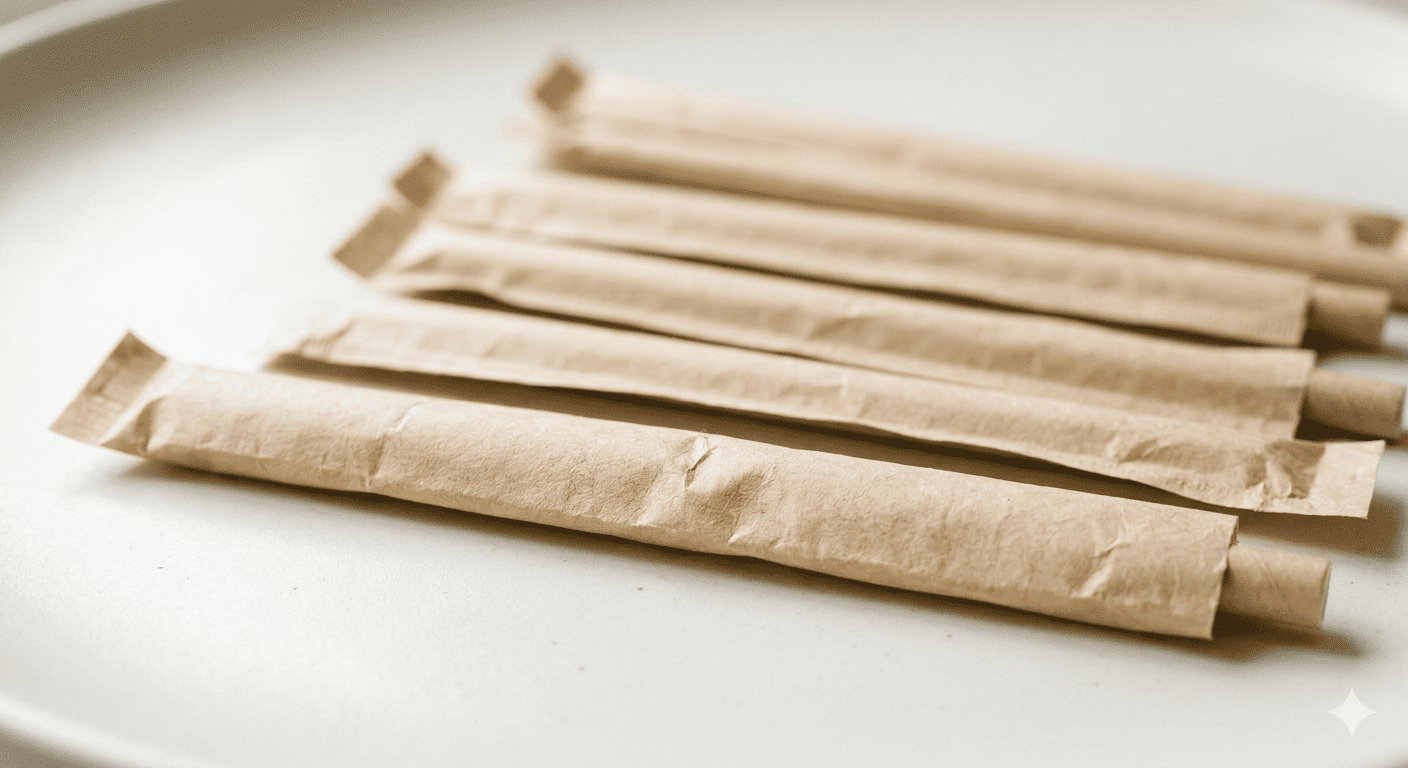
When I first started supplying paper straws, clients always asked if the straws were eco-friendly. Soon, the questions got more specific. They started asking about the wrappers. "Is the wrapper recyclable?" they would ask. It seems like a simple yes-or-no question. But in my years of experience sourcing paper, ink, and glue for these products, I've learned the answer is more complex. You need to know what you're buying before you can make any environmental claims. Let's look at what really makes a wrapper recyclable.
Choosing a wrapper seems simple, but one wrong choice can ruin your eco-friendly claims. It’s confusing to know what materials are truly recyclable and which ones are just greenwashing.
A recyclable wrapper is typically made of 100% uncoated paper with minimal, non-toxic ink and glue. Plastic coatings, heavy dyes, or food contamination often make the wrapper non-recyclable, sending it straight to the landfill. The material structure is the most important factor.
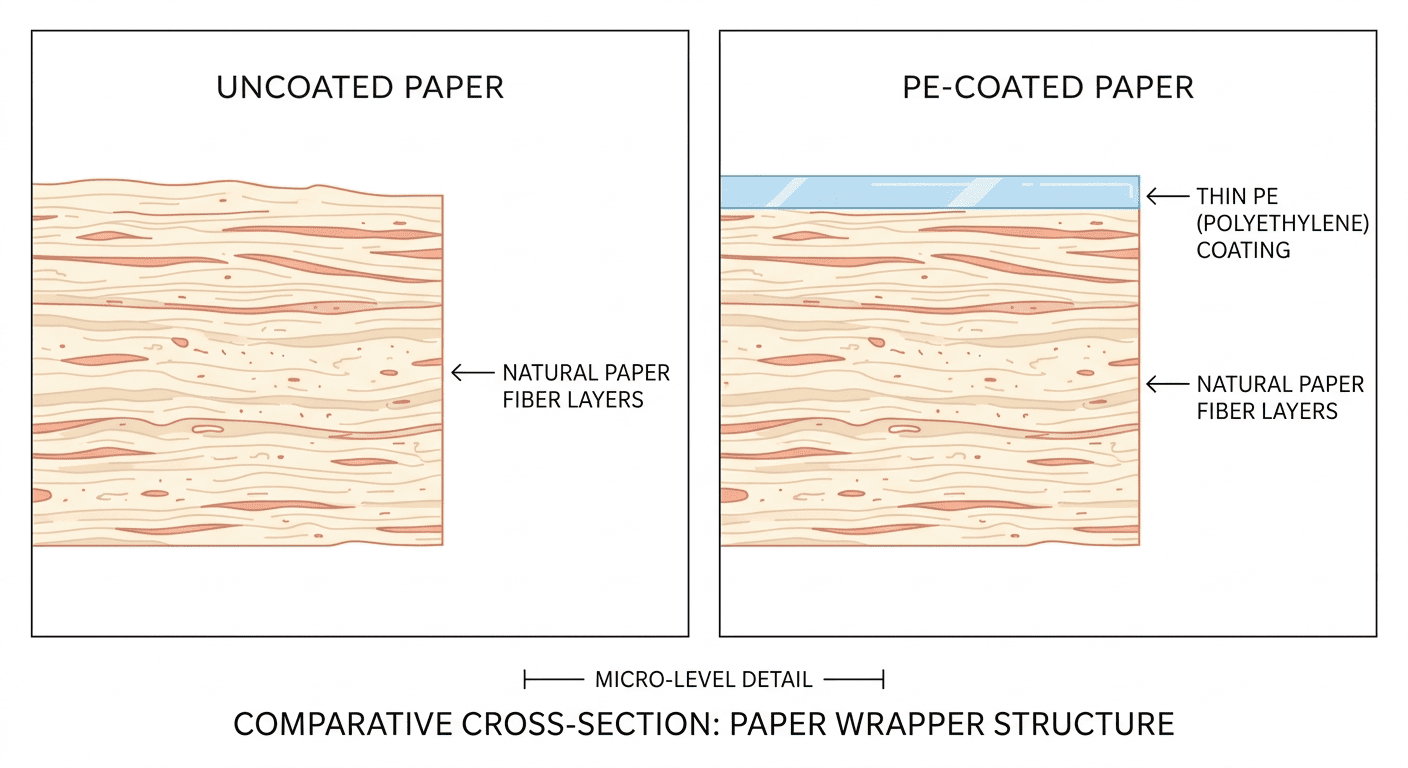
From my experience in the factory, the small details matter most. A customer might ask for a shiny, waterproof wrapper. That sounds great for branding, but that shine often comes from a thin layer of plastic (polyethylene, or PE). As soon as you add that plastic coating, the wrapper is no longer just paper. It becomes a mixed material. Most recycling facilities cannot separate that thin plastic layer from the paper fiber.4 So, the wrapper ends up in the trash. The same goes for ink and glue. We always guide our clients to use water-based inks and glues that dissolve easily during the re-pulping process. Heavy, oil-based inks can contaminate the entire batch of recycled paper.5
Here is a simple breakdown:
| Feature | Recyclable Version | Non-Recyclable Version |
|---|---|---|
| Paper Material | 100% uncoated paper | Paper with a PE/plastic coating |
| Ink | Minimal, water-based or soy-based ink | Heavy, metallic, or petroleum-based ink |
| Glue | Water-soluble adhesive | Synthetic hot-melt glue |
| Condition | Clean and dry | Soiled with food, grease, or liquid |
So, when you source wrappers, you have to ask your supplier these specific questions. It’s the only way to be sure you are not accidentally buying something destined for the landfill.
You see "eco-friendly" labels everywhere, but what do they really mean? Using the wrong term on your packaging can lead to big problems and serious customer distrust.
No, these terms are very different. 'Recyclable' means it can be reprocessed into new material. 'Biodegradable' means it breaks down naturally over time. 'Compostable' means it breaks down into nutrient-rich soil under specific conditions, usually in a commercial facility.
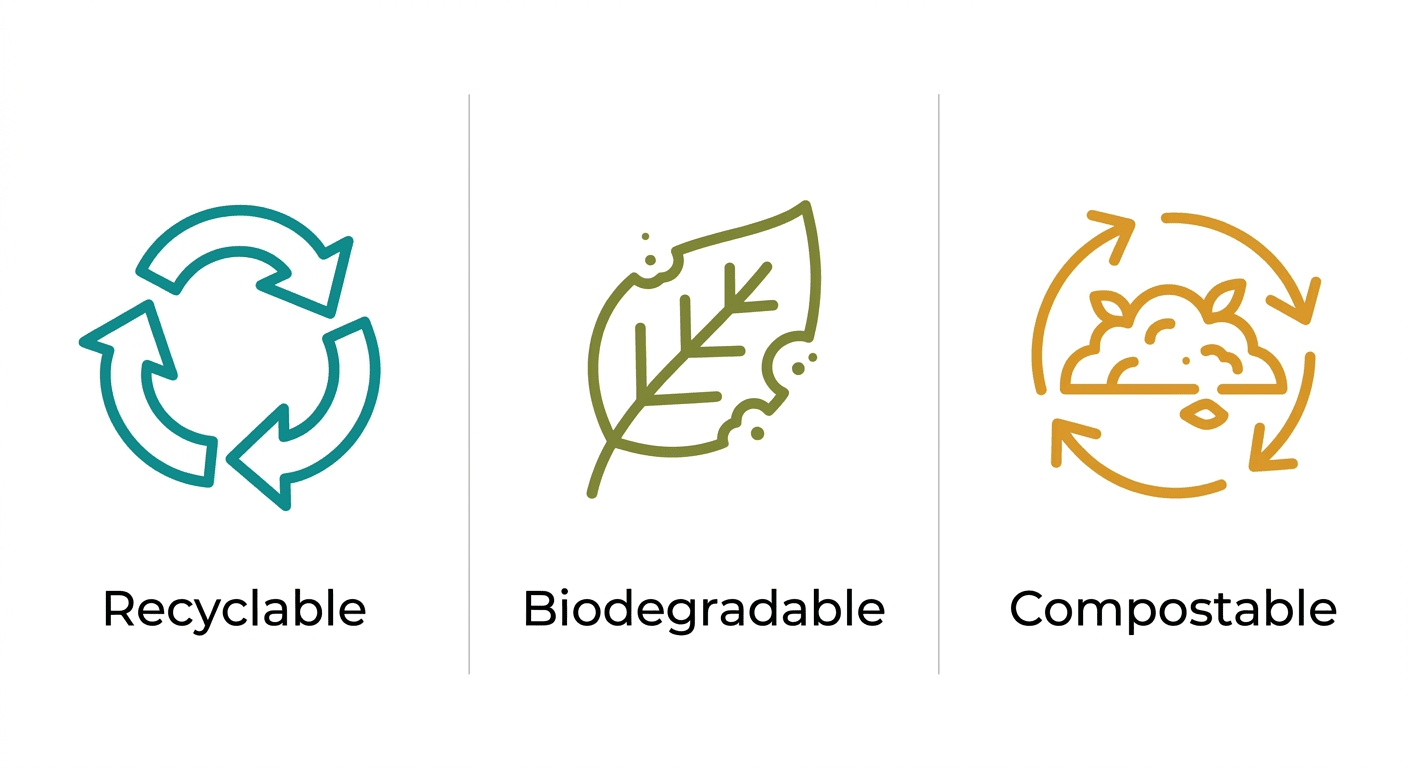
This is one of the biggest points of confusion I see with clients. A brand wants to be sustainable, so they ask for "biodegradable" wrappers. But they plan to tell their customers to recycle them. This creates a huge problem. Let me break down what each term actually means from a practical, material-science perspective.
A recyclable material is a resource. It can be collected, sorted, and reprocessed to make new products. For a paper wrapper, this means it goes to a facility, gets mixed with water to become a pulp, is cleaned of inks and glues, and then is pressed into new paper. The key here is infrastructure. A material is only recyclable if a facility exists that can and will process it.6
Biodegradable simply means that a material can be broken down by microorganisms like bacteria and fungi over time. The problem is, this term is very vague. A log of wood is biodegradable, but it takes decades. Many "biodegradable" plastics break down into smaller microplastics, which can still harm the environment.7 There are no strict time limits or conditions associated with this claim, making it easy to misuse.
Compostable is a much more specific claim. It means a material can break down into natural elements (humus) in a controlled environment. There are two main types: industrial composting and home composting. Industrial facilities use high heat to break things down quickly. A material must be certified (e.g., by BPI or TÜV Austria) to be called "compostable." You can't just throw a compostable wrapper in your backyard and expect it to disappear.8
| Term | What Happens? | What's Left? | Key Requirement |
|---|---|---|---|
| Recyclable | Reprocessed into a new product | New raw material (e.g., paper pulp) | Collection and processing facility |
| Biodegradable | Broken down by microbes | Water, CO2, biomass, maybe micro-particles | Time and natural environment |
| Compostable | Broken down in a controlled setting | Nutrient-rich soil (humus) | Specific heat, moisture, and microbes |
Understanding these differences is the first step to making honest sustainability claims.
You need to source wrappers for your straws, but how do you make a responsible choice? The risk of picking the wrong material is high, and a bad decision can be costly.
Focus on two things: your supplier's documentation and your local recycling capabilities. First, ask your supplier for detailed material specifications and any certifications (like FSC). Then, check directly with your local waste management services to see if they accept that specific type of material.

Over the years, I've developed a simple process to help my clients navigate this. It's less about finding a magic "eco-friendly" product and more about doing your homework. Here’s a practical checklist you can use.
Don't just ask, "Is it recyclable?" Be specific.
This is the step everyone forgets. A material is only truly recyclable if someone in your area will actually recycle it.
Once you have the facts, be transparent with your customers.
This approach protects your brand from greenwashing accusations and builds trust with your customers. It shows you've done the work.
Choosing a recyclable wrapper depends on the material, local rules, and clear communication. With the right information, you can make a responsible choice for your business and customers.
"What is recycling contamination? | In Our Nature - UW Sustainability", https://sustainability.uw.edu/blog/recycling-contamination. Sources from the recycling industry and materials science explain that plastic-coated paper is difficult to recycle because the plastic layer does not break down during the re-pulping process and contaminates the paper fiber slurry, requiring specialized, and often unavailable, processing to separate. Evidence role: mechanism; source type: research. Supports: The source should explain how plastic coatings, like polyethylene (PE), interfere with the hydropulping process, where paper is mixed with water to create a slurry. The plastic does not break down with the paper fibers and is difficult to separate, acting as a contaminant.. ↩
"Deinking", https://en.wikipedia.org/wiki/Deinking. Paper recycling research indicates that the composition of inks and adhesives is critical for recyclability. Water-based inks and water-soluble glues are preferred as they break down and disperse more easily during the re-pulping and de-inking stages, whereas other types can cause contamination. Evidence role: mechanism; source type: paper. Supports: The source should describe the de-inking and pulping stages of paper recycling and how certain materials, like oil-based inks or non-water-soluble glues, can be difficult to remove, leading to contamination of the recycled pulp.. ↩
"[PDF] Best Operational Practices Manual For Materials Recovery Facilities ...", https://www.csu.edu/cerc/researchreports/documents/BestOperationalPracticesManualForIllinoisRecyclers.pdf. Waste management experts and recycling facility operators confirm that small items, often defined as anything smaller than 2-3 inches in diameter, are typically too small to be properly sorted by the machinery at a Material Recovery Facility (MRF) and are often landfilled as residue. Evidence role: general_support; source type: government. Supports: The source should explain that Material Recovery Facilities (MRFs) use screens and other mechanical equipment to sort materials, and small, lightweight items often fall through the screens and are treated as residue, which is sent to a landfill.. ↩
"[PDF] The Separation of Low Density Polyethylene Laminates from Paper", https://scholarworks.wmich.edu/cgi/viewcontent.cgi?article=1480&context=engineer-senior-theses. Studies on paper recycling technology show that separating the plastic layer from polycoated paper requires specialized equipment not present in most standard recycling facilities, making such materials a common contaminant that is typically landfilled. Evidence role: mechanism; source type: research. Supports: The source should explain that while technologies exist to separate plastic from paper, they are not standard at most Material Recovery Facilities (MRFs) due to cost and complexity, making polycoated paper effectively non-recyclable in most municipal systems.. ↩
""The Deinkability of Different Papers Printed with Soy and Petroleum ...", https://scholarworks.wmich.edu/honors_theses/508/. Research in paper science confirms that certain inks, particularly those that are petroleum-based or contain heavy metals, are resistant to standard de-inking processes. This can lead to visible specks and discoloration, downgrading the quality of the recycled paper batch or rendering it unusable. Evidence role: mechanism; source type: paper. Supports: The source should detail how oil-based and metallic inks are difficult to remove during the de-inking flotation process, leading to specks, discoloration, and reduced quality in the resulting recycled paper pulp.. ↩
"[PDF] Part 260 – Guides for the Use of Environmental Marketing Claims", https://www.ftc.gov/sites/default/files/attachments/press-releases/ftc-issues-revised-green-guides/greenguides.pdf. The U.S. Federal Trade Commission's (FTC) Green Guides state that for a product to be marketed as recyclable, recycling facilities must be available to a substantial majority of consumers or communities where the product is sold. Evidence role: definition; source type: government. Supports: The source should provide the official definition of 'recyclable,' which typically includes the requirement that collection and processing facilities are available to a substantial majority of consumers or communities where the item is sold.. ↩
"Oxo-degradable Plastics Risk Environmental Pollution", https://smallfruits.wsu.edu/2025/12/17/oxo-degradable-plastics-risk-environmental-pollution/. A report from the UN Environment Programme warns that so-called 'biodegradable' plastics often fragment into microplastics that persist in the environment, particularly in marine ecosystems, without fully breaking down into natural elements. Evidence role: expert_consensus; source type: institution. Supports: The source should explain that many plastics marketed as 'biodegradable' (especially oxo-degradable ones) do not fully mineralize but instead fragment into microplastics, which persist in and can harm the environment.. ↩
"Compost Physics - CORNELL Composting", https://compost.css.cornell.edu/physics.html. Environmental science resources explain that industrial composting facilities maintain high temperatures (above 130°F) needed to break down certified compostable materials like PLA, whereas backyard compost piles typically do not get hot enough, meaning these materials will persist for a very long time. Evidence role: mechanism; source type: education. Supports: The source should explain that industrial composting facilities reach sustained high temperatures (130-160°F or 55-70°C) that are necessary to break down certified compostable bioplastics, conditions that are rarely met in a typical backyard compost pile.. ↩
"Forest Stewardship Council", https://hrlibrary.umn.edu/links/fscprinciples.html. The Forest Stewardship Council (FSC) is an international non-profit organization that promotes responsible management of the world's forests. FSC certification ensures that products come from responsibly managed forests that provide environmental, social, and economic benefits. Evidence role: definition; source type: institution. Supports: The source should be from the Forest Stewardship Council itself, defining its mission and explaining that its certification provides a chain of custody from a forest managed to its environmental and social standards through to the final product.. ↩
"Food Packaging & Other Substances that Come in Contact with Food", https://www.fda.gov/food/food-ingredients-packaging/food-packaging-other-substances-come-contact-food-information-consumers. The U.S. Food and Drug Administration (FDA) regulates materials that come into contact with food, known as food-contact substances, to ensure they are safe and do not leach harmful chemicals into the food. Similar regulations, like the LFGB in Germany, exist in other jurisdictions. Evidence role: general_support; source type: government. Supports: The source should be from a regulatory agency like the U.S. Food and Drug Administration (FDA), defining 'food-contact substances' and outlining the requirements for these materials to be considered safe for their intended use.. ↩