
Your hotel needs branded straws, but you worry they'll disappoint guests. Cheap ones get soggy and reflect poorly on your brand. It's a common problem with a simple solution.
To protect your hotel's image, choose branded paper straws based on performance, not just price. Focus on durability in drinks, ink safety for logos, and correct sizing for different beverages. Low-quality straws can create guest complaints and damage your premium brand's reputation with every sip1.

I've been in the paper straw business since 2012, and I've seen many hotels make the same mistake. They spend a fortune on marketing, decor, and service, only to undermine it with a cheap, soggy paper straw. A guest's final impression of a carefully crafted cocktail shouldn't be a dissolving piece of paper. You're not just buying a straw; you're buying a small piece of your guest's experience. Making the right choice is simpler than you think, and it starts with asking better questions. Let’s look at how to choose a straw that helps, not hurts, your brand.
You found a supplier offering very cheap branded straws. But after a few weeks, you hear complaints about them falling apart in drinks. This is a common issue with low-cost options.
Cheap paper straws often create complaints because they are made with poor-quality paper and glue2. This causes them to get soggy quickly, leave a papery taste, or even have a chemical smell3. These issues ruin the drink experience and make your luxury brand seem cheap.

In our factory, we see exactly where costs are cut. It's all in the raw materials. To make a straw cheaper, a factory might use thinner paper or a weaker, non-food-grade glue4. The result is a straw that can't survive in a cold, icy drink for more than ten minutes. For a hotel guest relaxing by the pool, that's not long enough. A good paper straw should last for hours5. We learned this from running our own 10 production lines. Bad materials also lead to other problems. The ink used for the logo might not be food-safe6, or the straw might have a strange odor from the glue. These small details add up to a bad guest experience. You're not just buying a straw; you are placing a branded item directly into your customer's mouth. The risk of getting it wrong is much higher than the few cents you save per unit.
| Risk of Low-Cost Straws | Feature of Quality Straws |
|---|---|
| Gets soggy in < 15 mins | Stays firm for 3+ hours |
| Unpleasant paper taste | Odorless and tasteless |
| Blurry or smudged logo | Sharp, clear logo print |
| Potential ink transfer | Food-safe, stable ink |
| Inconsistent batches | Uniform quality control |
You asked a supplier to put your logo on a straw. But when the shipment arrived, the colors were wrong and the logo was blurry. Your brand now looks unprofessional.
True brand customization goes beyond just a logo. It includes precise color matching to your brand's Pantone, using safe, high-clarity ink, and choosing a wrapper that complements your presentation. Anything less can misrepresent your brand's commitment to quality and detail.
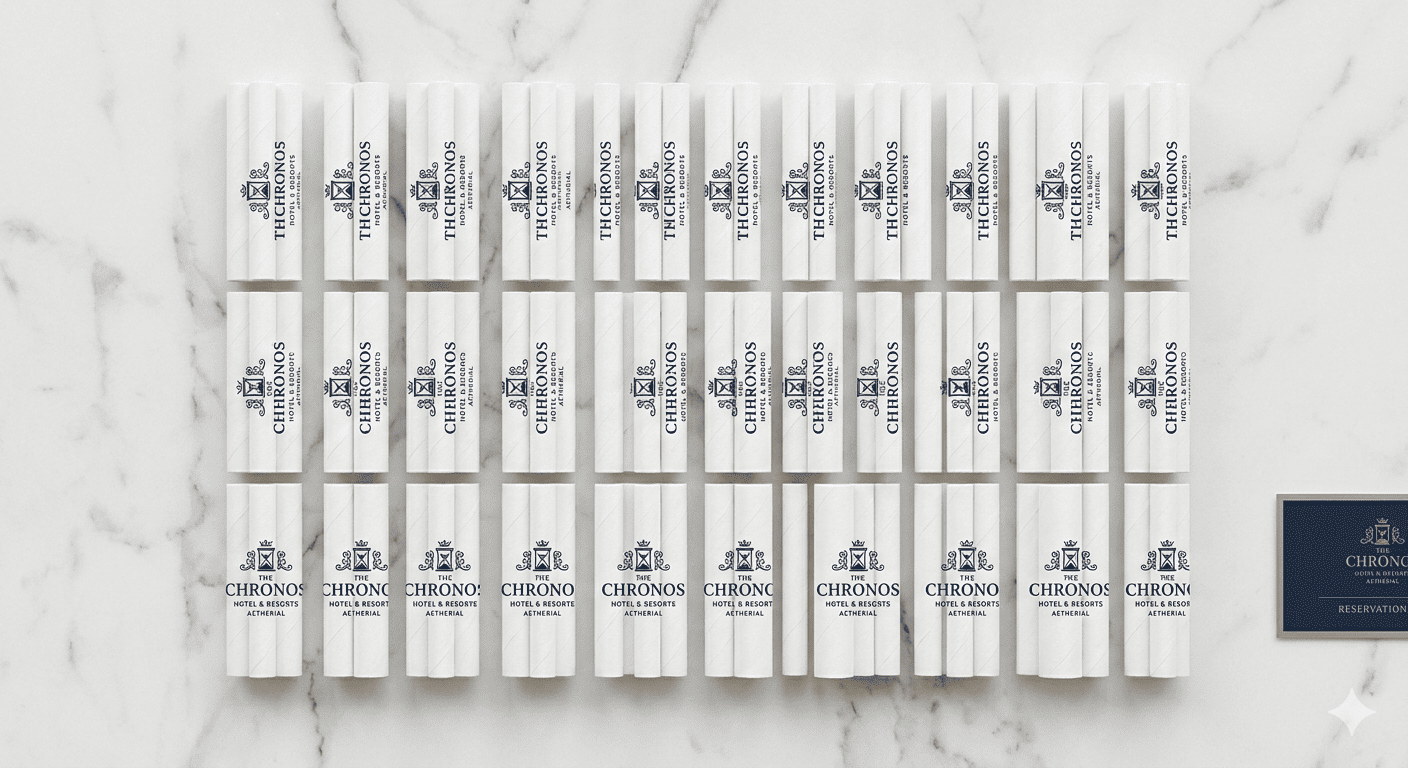
I often talk to procurement managers who just say, "I need my logo on a straw." But a logo is just the beginning. The real conversation should be about representing your brand perfectly. For example, your hotel has a specific shade of blue in its branding. We need to match that exact Pantone color7, not just a generic "blue." This requires specific inks and careful testing. The ink itself must be food-grade and stable, so it doesn't smudge or leach into the drink. We also discuss how the logo is printed. Should it be a repeating pattern or a single, centered emblem? All these choices affect the final look. Then there's the packaging. A single paper-wrapped straw feels more premium8 for room service than a bulk box for the bar. True customization is a partnership to get every detail right, ensuring the straw enhances your brand, not just carries its name.
You sourced one type of straw for the entire resort to save time. Now, bartenders complain the straws are too narrow for smoothies, and they look too casual for cocktails.
No, different service areas often need different straws. A poolside bar serving frozen drinks needs wide-bore, durable straws, while a fine dining restaurant may require a sleeker, individually wrapped straw. Using one size for all can lead to poor function and a mismatched aesthetic.
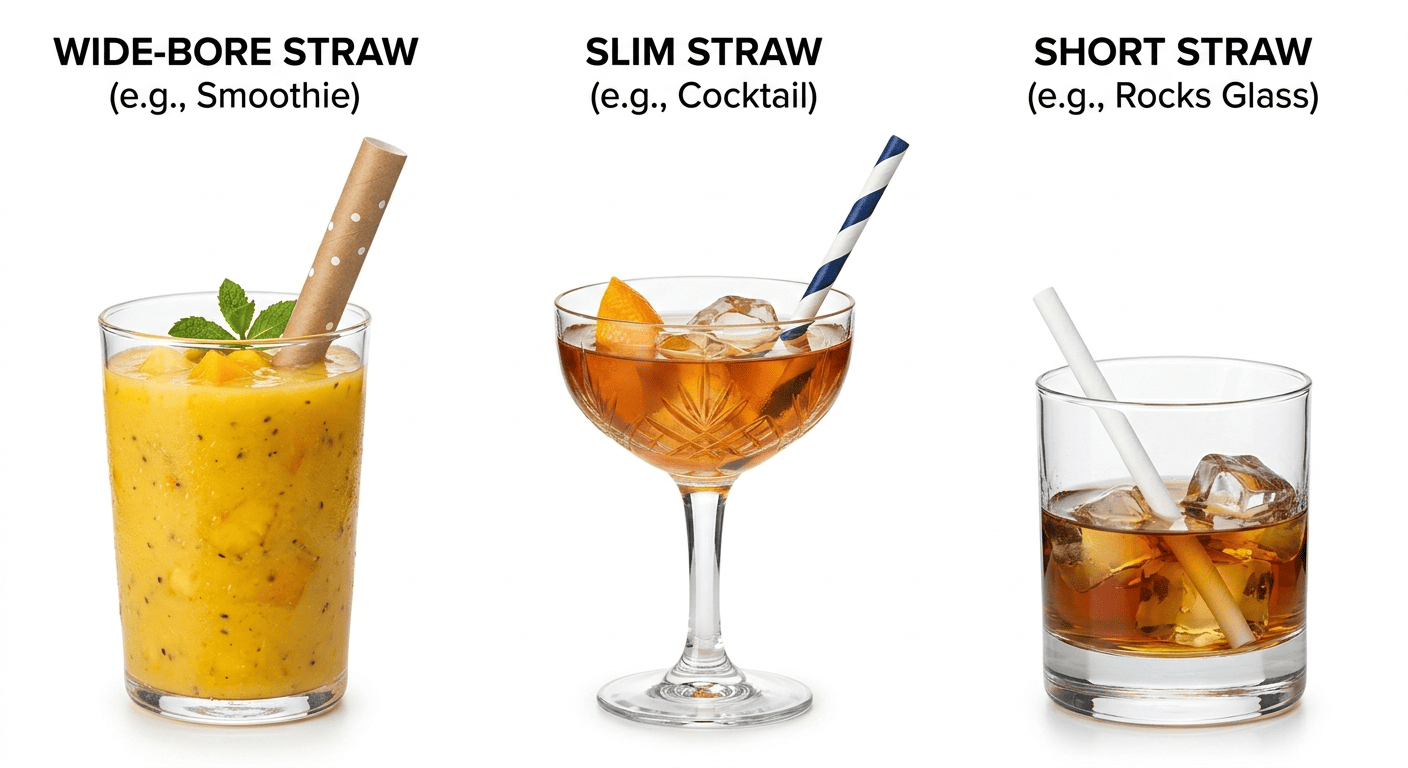
Thinking about the drink menu is the most important step. As manufacturers, we produce straws in many diameters and lengths for this reason. A thick milkshake or a smoothie with fruit chunks needs a wide-bore straw, typically 10mm or 12mm in diameter9. Using a standard 6mm straw would just frustrate your guest. For a highball glass with an iced tea or cocktail, a long, standard-diameter straw is perfect. But for a short rock's glass, that same straw would look awkward. You need a shorter cocktail straw. It’s also about durability. A straw for a poolside daiquiri that sits in the sun needs to be extra sturdy to handle condensation and ice for a long time10. The straw for a quick breakfast juice doesn't need the same level of performance. We help our clients think through these scenarios to build a "straw plan" for their entire property.
| Hotel Scenario | Recommended Straw Type | Why It Works |
|---|---|---|
| Poolside Bar (Smoothies) | Wide Bore (10-12mm), Unwrapped | Handles thick drinks, easy for staff to grab. |
| Fine Dining (Cocktails) | Standard/Slim (6-8mm), Paper-wrapped | Elegant look, hygienic, matches tall glassware. |
| Guest Room Minibar | Short Cocktail (5-6mm), Paper-wrapped | Fits small glasses and cans, hygienic presentation. |
| Breakfast Buffet (Juice) | Standard (6mm), Bulk Dispenser | Cost-effective for high volume, works for thin liquids. |
You need to order straws but don't want to repeat past mistakes. Simply asking for the price and MOQ feels risky, but you don't know what else to ask.
Start the conversation by describing your use case, not by asking for a price. Tell the supplier the type of drinks, the expected duration of use, and your brand's quality standards. This shifts the focus from cost to finding the right solution for your guests.

The best way to get a good product is to have a good conversation. Instead of just sending an email that says, "What is your price for 100,000 branded straws?", you will get much better results by providing context. I advise my clients to start with their needs. For example, "We need a straw for our lobby bar. It will be used in iced cocktails and must last at least two hours. Our brand color is Pantone 186 C. Can you send a sample that matches this?" This tells a supplier everything they need to know. It shows that you value quality and performance. It also allows us, as the manufacturer, to recommend the right product from the start. A good supplier will welcome these questions. They should be able to provide documentation for their materials, like FSC for paper11 or food-contact safety reports for the glue and ink12, for your specific order. Always ask for production samples before confirming a bulk order. This ensures what you approved is what you get.
Choose your branded straws as a key part of the guest experience. Focus on drink performance, brand accuracy, and supplier transparency to protect your hotel's reputation with every single order.
"The Psychology of Branding: How Emotions Drive Customer Loyalty", https://online.emporia.edu/degrees/business/mba/marketing/psychology-of-branding/. Research in consumer behavior indicates that brand perception is shaped by the sum of all customer touchpoints, and negative experiences with seemingly minor details can disproportionately harm the perception of a luxury or premium brand. Evidence role: general_support; source type: paper. Supports: The claim that minor details in the customer experience, such as the quality of a disposable item, can significantly influence a guest's overall perception of a premium brand.. Scope note: The source will likely discuss general principles of brand management and customer experience rather than focusing specifically on paper straws in a hotel setting. ↩
"Sizing and its Effect of Paper-Polymer Adhesion - BioResources", https://bioresources.cnr.ncsu.edu/resources/sizing-and-its-effect-of-paper-polymer-adhesion/. Studies on paper-based food contact materials show that structural integrity in aqueous environments depends on factors like paper density, fiber length, the use of sizing agents, and the type of adhesive used for lamination, with lower-grade materials exhibiting faster liquid absorption and degradation. Evidence role: mechanism; source type: paper. Supports: The claim that the durability of a paper straw in liquid is determined by the quality of its raw materials, specifically the paper's composition and the water resistance of the adhesive.. ↩
"Off-flavour release from packaging materials and its prevention", https://pubmed.ncbi.nlm.nih.gov/11962711/. Sensory and chemical analyses of single-use beverage straws have identified the migration of substances from paper straws into drinks, which can result in detectable off-flavors, including a 'papery' or 'cardboard' taste. Evidence role: case_reference; source type: paper. Supports: The claim that some paper straws can negatively affect the taste and smell of a beverage.. Scope note: The findings may vary significantly between different brands and types of paper straws tested. ↩
"21 CFR Part 175 - Adhesives and Components of Coatings - eCFR", https://www.ecfr.gov/current/title-21/chapter-I/subchapter-B/part-175. Regulatory bodies such as the U.S. Food and Drug Administration (FDA) maintain specific regulations for adhesives intended for use in food-contact applications, ensuring that their components are not expected to migrate into food at levels that would pose a safety risk. Evidence role: definition; source type: government. Supports: The claim that specific regulations exist for adhesives used in food-contact items and that using non-compliant glue is a potential issue.. Scope note: The source will define the regulations but is unlikely to provide data on the prevalence of non-compliant glue in the market. ↩
"Evaluation of paper straws versus plastic straws - BioResources", https://bioresources.cnr.ncsu.edu/resources/evaluation-of-paper-straws-versus-plastic-straws-development-of-a-methodology-for-testing-and-understanding-challenges-for-paper-straws/. Independent testing of commercially available paper straws has shown significant variability in durability, with higher-quality products maintaining their structural integrity in liquids for periods exceeding three hours, while others fail in under 30 minutes. Evidence role: statistic; source type: research. Supports: The claim that high-quality paper straws can and are expected to last for several hours in a beverage.. Scope note: Performance metrics can vary based on the testing liquid's temperature, acidity, and carbonation. ↩
"Identification of print-related contaminants in food packaging - PubMed", https://pubmed.ncbi.nlm.nih.gov/26789986/. Regulations for food contact materials extend to printing inks, which must be formulated to prevent the migration of harmful substances, such as heavy metals or unapproved colorants, from the packaging or item into the food or beverage. Evidence role: general_support; source type: government. Supports: The claim that inks used on food-contact items like straws must meet specific safety standards.. ↩
"Pantone - Wikipedia", https://en.wikipedia.org/wiki/Pantone. The Pantone Matching System (PMS) is a proprietary color space used in a variety of industries, primarily printing, to ensure color consistency. It allows designers to color-match specific colors regardless of the equipment used to produce the final product, which is critical for maintaining brand identity across different materials. Evidence role: definition; source type: encyclopedia. Supports: The claim that Pantone is the standard for precise color matching in branding.. ↩
"Customer Perceptions of Restaurant Cleanliness: A Cross Cultural ...", https://vtechworks.lib.vt.edu/items/ecbbec37-d7d0-40ef-ab43-3a46fafdcf6a. Studies in consumer psychology suggest that individual packaging for consumable items in hospitality settings can act as a signal of hygiene and care, enhancing the guest's perception of quality and contributing to a more premium experience. Evidence role: general_support; source type: paper. Supports: The claim that individual wrapping enhances the perceived quality and hygiene of an item in a service setting.. Scope note: The research may focus on general principles of packaging and perception rather than specifically on straws in a hotel bar or restaurant. ↩
"Material Requirements for Food Service Ware | doee - DC.gov", https://doee.dc.gov/foodserviceware. Food service industry guidelines specify different straw types for various beverages, recommending 'jumbo' or 'giant' straws with diameters of 10mm or more for thick drinks like milkshakes, smoothies, and frozen cocktails to ensure functionality and ease of consumption. Evidence role: general_support; source type: other. Supports: The claim that specific straw diameters are recommended for different types of beverages based on their thickness.. Scope note: Source may be a trade publication or supplier guide rather than a formal academic or government standard. ↩
"Wet strength - Wikipedia", https://en.wikipedia.org/wiki/Wet_strength. The material science of paper shows that its tensile strength decreases significantly when wet. In the context of a cold beverage, constant condensation on the exterior of the straw, in addition to the liquid inside, accelerates water absorption and can lead to a more rapid loss of structural rigidity. Evidence role: mechanism; source type: paper. Supports: The claim that condensation on a cold drink accelerates the weakening of a paper straw.. ↩
"Forest Stewardship Council - Wikipedia", https://en.wikipedia.org/wiki/Forest_Stewardship_Council. The Forest Stewardship Council (FSC) is an international non-profit organization that promotes responsible management of the world's forests. FSC certification provides assurance that paper products are sourced from forests that are managed to meet stringent environmental, social, and economic standards. Evidence role: definition; source type: institution. Supports: The claim that FSC is a relevant and important certification for paper products.. ↩
"About the FCS Review Program - Food Contact Substance ... - FDA", https://www.fda.gov/food/inventory-effective-food-contact-substance-fcs-notifications/about-fcs-review-program. Manufacturers of food contact materials are often required to provide a Declaration of Compliance (DoC) or similar documentation. These reports certify that the product complies with relevant legal regulations, such as EU Regulation 1935/2004 or FDA codes, ensuring that materials like glue and ink are safe for their intended use. Evidence role: definition; source type: government. Supports: The claim that formal documentation exists to verify the safety of materials used in items like straws.. ↩