You’re evaluating two suppliers for "food grade" paper straws. One sends you a single certificate for their paper stock. The other sends three separate lab reports for paper, glue, and ink. Which supplier is providing a clearer picture of compliance?
This isn’t a simple question. A "food grade" claim on a website or in an email is a starting point, not a final answer. The risk is assuming all "food grade" claims are equal. They are not. A misunderstanding here can lead to rejected shipments, failed customer audits, or stocking a product you can’t confidently sell.
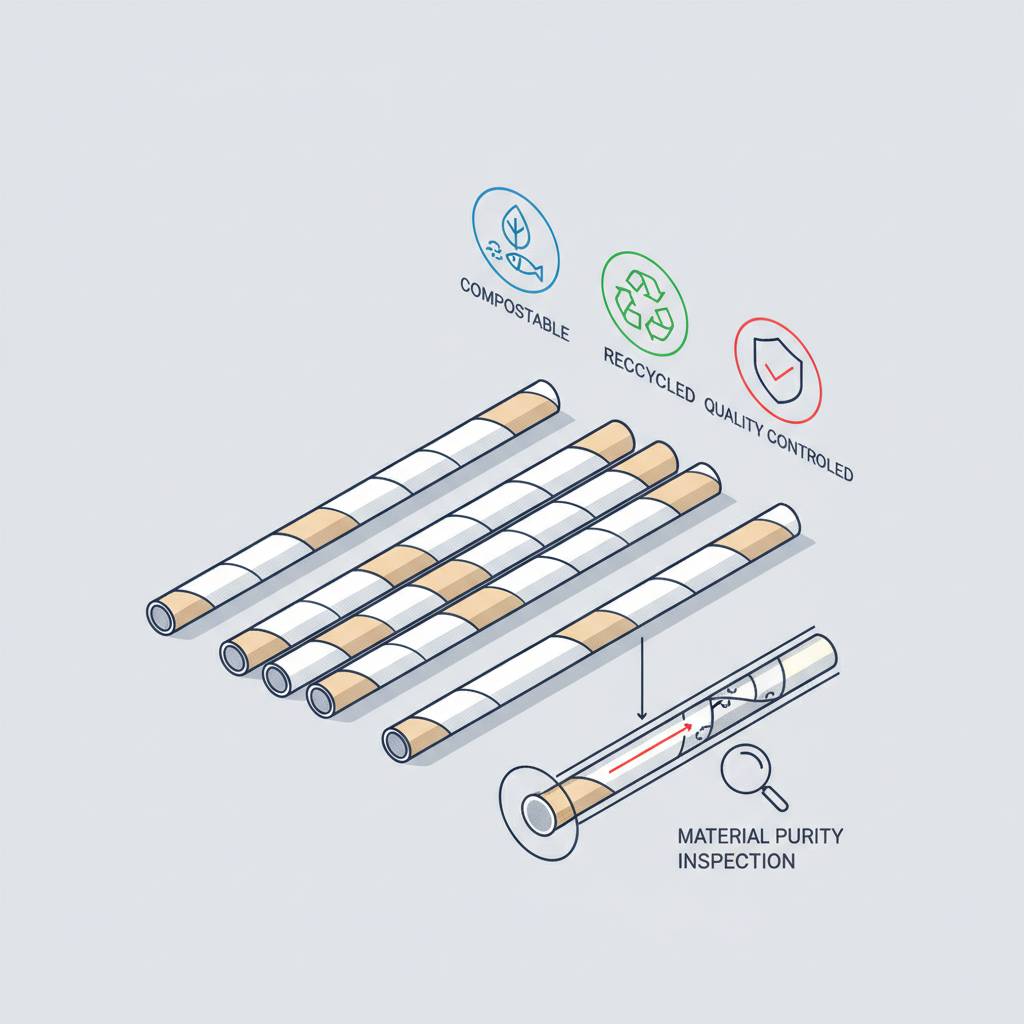
To confirm paper straws are food grade, buyers should ask for recent, third-party test reports relevant to their target market (e.g., reports showing compliance with FDA regulations for the USA, or LFGB for the EU). These documents should cover all three components that may contact the drink: the paper, the adhesive (glue), and any printing inks.
From our side as a supplier, when an inquiry asks for "the" food grade certificate, it’s a sign we need to slow down the conversation. There isn’t just one. A more useful starting point is to discuss your market – is it the US or the EU? The required documents for each are different, and an experienced supplier should be prepared to provide the correct ones.
It means that all materials used to make the straw are considered suitable for contact with food and beverages under normal use conditions. The mistake is thinking of a paper straw as one item. It’s an assembly of at least two, and often three, separate components:
1. The Paper: The body of the straw. 2. The Adhesive (Glue): The bonding agent that holds the paper layers together. 3. The Printing Ink: Used for logos, branding, or decorative patterns.
A test report that only covers the paper stock does not prove the suitability of the glue or the ink. A complete compliance package should address all components that might leach into the drink. A supplier’s claim is only as strong as the documentation they can provide to support it for the entire, finished product.

Instead of asking "Are you certified?", a more precise question is, "Can you provide the food contact material (FCM) test reports for the paper, adhesive, and ink used in these straws?"
You are looking for third-party laboratory reports, not just a supplier’s self-signed "Declaration of Conformity" (DoC). While a DoC is a required document in some markets (like the EU), it should be backed by evidence. The lab reports are that evidence.
Specifically, ask for reports that show compliance with the regulations of your target market:
If a supplier can only provide a report for the paper, you should ask what proof they have for the glue and ink.
Receiving a PDF file is not enough. You should perform a quick review of the document. You don’t need to be a chemical engineer; you just need to check a few key details.
Open the report and look for these four things:
1. Applicant Name: Does the company name on the report match the supplier you are talking to? If it doesn’t, the report might belong to their raw material provider. This is common, but the supplier should be able to provide documentation linking that material to your finished product. 2. Report Date: How old is the report? Regulations and material formulations can change. A report that is several years old is less reliable. Ask the supplier to confirm the tested materials are still in use for your order. 3. Material Description: Does the report describe the product you are buying? A report for "white kraft paper" is useful, but you still need verification for the glue and any colored inks. 4. Testing Laboratory: Is the report from a known, accredited third-party lab? A report from an unverified or in-house lab may not be accepted by customs or major clients.
If a supplier hesitates to share full, unredacted lab reports, treat it as a reason to slow down. Transparency in documentation is where trust in compliance begins.
Buyers often receive various certificates and can easily confuse them. A factory’s quality management certificate (ISO 9001) is not the same as a product’s food safety report. This table clarifies the difference.
| Document Type | What It Typically Proves | What It Does NOT Prove (And What to Ask Next) |
|---|---|---|
| Paper Material Test Report | The paper stock meets relevant food contact standards. | The suitability of the glue or ink used to assemble the straw. Ask: "Can you also provide reports for the adhesive and ink?" |
| Adhesive/Glue Test Report | The glue used to bind the paper layers meets food contact standards. | The suitability of the paper or ink. Ask: "Can you confirm this tested glue is used in all your production for us?" |
| Printing Ink Test Report | The ink used for logos or designs meets food contact standards. | The suitability of the paper or glue. Ask: "Does this report cover all the ink colors used in my design?" |
| ISO 9001 Certificate | The supplier has a documented quality management system in their factory. | That the product itself is suitable for food contact. It’s a process certificate. Ask: "Thank you. Now, can we review the food contact test reports?" |
| Compostability Certificate | The straw biodegrades under specific industrial composting conditions, as verified by a third-party body. | That the straw is suitable for food contact. Food safety and compostability are separate. Ask: "This is great for our eco-claims. What about food safety reports?" |
If a supplier provides a single test report for the paper and claims this makes the entire straw "food grade," it is an incomplete answer.
Your response should be direct and practical. Ask them:
How they respond is very telling. A well-organized supplier should have these documents on file and be able to provide them. A supplier who cannot, or who tries to convince you the paper report is sufficient, may not have a robust compliance system. The price difference between two quotes often comes down to this: one supplier has invested in testing and using compliant glue and ink, and can prove it.
Before you finalize your supplier choice, make your inquiry more effective. A clear request helps you compare suppliers on an equal basis and helps make the quotation you receive more reliable.
When you send your product specifications (size, wrapping, quantity), also include two key questions:
1. "Our target market is [e.g., the USA / Germany / France]. Can you provide current, third-party food contact test reports for the paper, adhesive, and any printing inks that are relevant to this market?" 2. "Can you confirm that the applicant name on the reports is your company, or provide documentation linking your product to the report?"
This approach moves the conversation from a vague claim to concrete evidence. It helps you identify suppliers who take compliance seriously and reduces the risk of discovering documentation gaps during a customs inspection or a client audit, when it’s often too late.