
Ordering custom paper straws for your business seems simple until a bulk shipment arrives. The straws match the quotation, but they’re too short for your takeaway lids, too narrow for your new smoothie, or the cartons are too bulky for your warehouse. This mistake—choosing a size that looks correct on paper but fails in real service—can lead to customer complaints, unusable inventory, and higher-than-expected freight costs.
The best custom paper straw size is the one that matches the actual cup, lid, drink thickness, serving style, and packing requirements—not simply the longest, widest, or cheapest option.
Choosing the right specification is a procurement risk decision. It affects drink usability, customer satisfaction, Minimum Order Quantity (MOQ), packing efficiency, carton CBM, and your total landed cost. This guide explains how to select the right length and diameter for your drinks, what to test before ordering in bulk, and what details to confirm with your supplier to avoid costly mistakes.
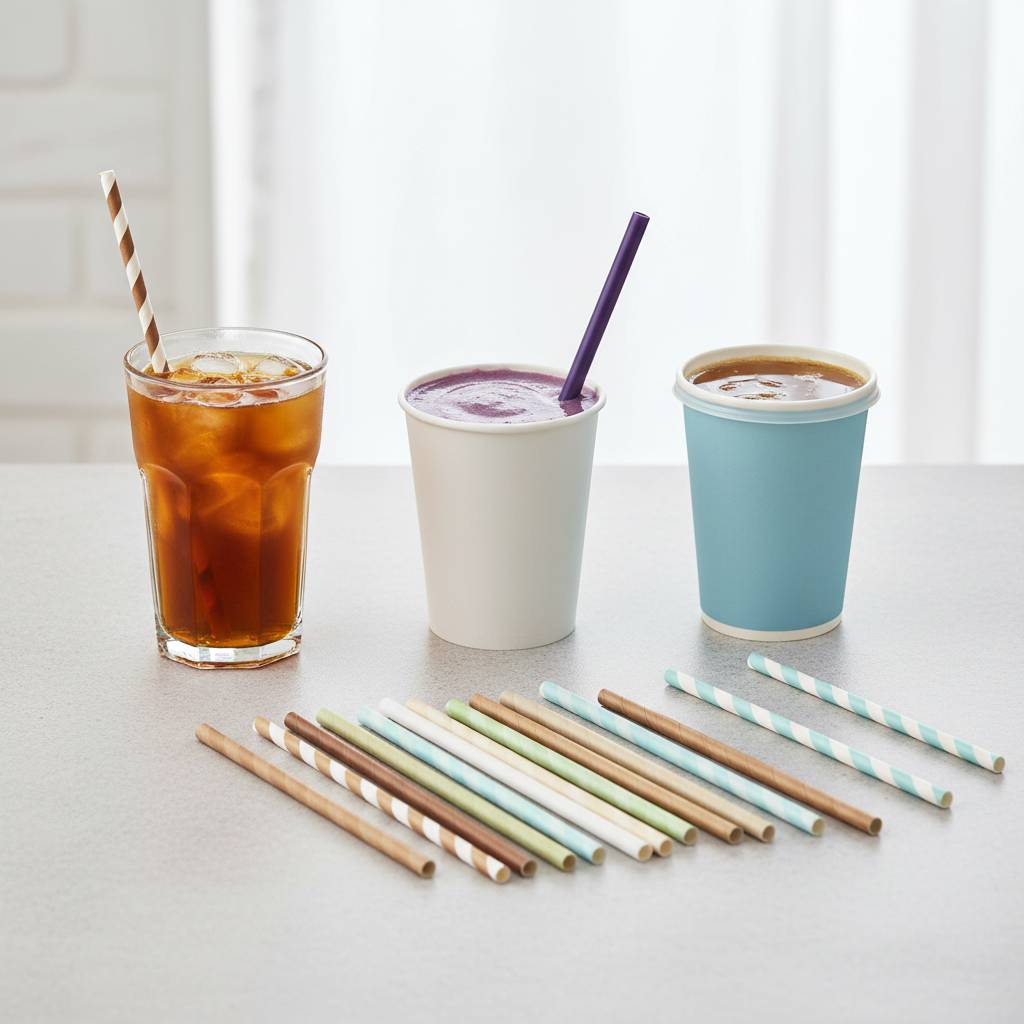
You must select straw length based on the complete serving setup—cup, lid, and ice level—not just the cup height alone.
Many buyers assume a straw is correct if it’s taller than the cup, but this thinking is incomplete. The biggest mistake is forgetting the lid. A flat lid, a domed lid, or a specialty takeaway lid can significantly change the required usable length. A straw that seems fine in an open cup might become too short once a lid is applied, forcing customers to struggle.
When we work with buyers, I always ask for details on both their cup and lid. A straw that is awkwardly long can look unprofessional in a smaller cup, wastes material, and can even reduce packing efficiency, which increases carton volume. Choosing the longest straw "to be safe" often creates avoidable costs that repeat with every order.
Before confirming a length, test samples with your actual cups and lids. Check that a comfortable amount of straw remains exposed for drinking, even when ice is added. The goal is to find the optimal length that works for the end-user without inflating your procurement and logistics expenses.
The right diameter is determined by the drink’s viscosity and texture, not just by appearance.
While length affects fit, diameter is critical for function and customer satisfaction. A diameter mismatch is one of the most common sources of complaints in the beverage industry.
Thin drinks like water, soda, juice, and iced coffee flow easily and don’t require an oversized diameter. Using a wider-than-needed straw for these drinks increases your material cost and can reduce packing efficiency. Conversely, thick drinks like smoothies, milkshakes, and blended beverages require a wider diameter to ensure a smooth, comfortable flow. A straw that is too narrow for a thick drink will frustrate customers.
The real challenge comes with drinks containing pulp, boba, foam, or crushed ice. For these, a simple measurement is not enough; you must test the straw in the real-world serving condition. Before ordering, group your drinks into categories based on thickness and test wider diameter options for any beverage that is blended, thick, or contains solids.
| Drink or Serving Scenario | Main Buyer Concern | Length Selection Logic | Diameter Selection Logic | What to Test Before Bulk Order |
|---|---|---|---|---|
| Water, soda, juice | Basic drinking comfort | Match actual cup and lid height | Standard or narrower diameter may be enough | Cup fit, lid fit, drinking comfort |
| Iced coffee or cold tea | Cup/lid compatibility and ice level | Check takeaway lid and exposed straw length | Avoid oversizing if the drink is thin | Ice level, lid opening, exposed length |
| Smoothies or milkshakes | Drink thickness | Match the real serving cup, often taller cups | Wider diameter may be needed | Flow rate, suction comfort, serving time |
| Drinks with pulp or blended texture | Blockage and flow | Confirm with real serving cup and lid | Test wider diameter options | Pulp flow, blockage risk, customer comfort |
| Distributor mixed demand | Inventory balance | Stock practical common lengths for market demand | Avoid too many slow-moving diameters | MOQ per size, market demand, carton efficiency |
This table helps you match straw specifications to real-world drink requirements, moving the decision from guesswork to a structured process.

A single straw size can simplify inventory, but it’s a risky strategy for any business with a diverse drink menu.
While tempting, the "one-size-fits-all" approach often fails to deliver a good customer experience across all products. One size might work if your menu is very simple—for example, only serving sodas in one cup size. But as soon as you add milkshakes, tall glasses, or kids’ drinks, the single-size model breaks down. For distributors, stocking only one size is even riskier, as it limits the range of customers you can serve effectively.
From a supplier’s perspective, the best approach is to choose the fewest sizes that can still cover your main use cases. This involves grouping drinks and cups into categories. For example, you might need: 1. A standard size for soft drinks and juices. 2. A longer size for tall takeaway cups. 3. A wider-diameter size for smoothies and thick drinks.
Before deciding, analyze your menu and cup inventory. Group drinks into categories based on viscosity and serving vessel. This will help you determine the minimum number of straw SKUs you need to stock while balancing operational simplicity, customer experience, and the MOQ for each custom size.
The unit price on a quotation is only a small part of the story; custom straw dimensions directly influence your total landed cost.
Many buyers compare suppliers solely on the price-per-straw, ignoring how size impacts everything from material usage to freight. Here’s what happens on the production side:
When requesting a quote, ask for the full packing details, not just the unit price. Specifically, request the pieces per carton, carton dimensions (L x W x H), and total CBM for your order quantity. The choice isn’t just about the cheapest straw; it’s about the most cost-effective solution from the factory to your warehouse.
| Specification Change | Possible Cost Impact | Operational Impact | Buyer Question to Ask Supplier |
|---|---|---|---|
| Longer straw length | More material use; possible higher unit cost | May affect carton size and packing efficiency | Does this length change pieces per carton or total CBM? |
| Wider straw diameter | More material use; possible lower packing quantity | May increase carton volume and storage space | Is this diameter necessary for our drink type? |
| Multiple custom sizes | MOQ may apply to each size | More inventory planning required | What is the MOQ for each custom size? |
| Individual wrapping | Higher packing cost | Better hygiene perception; different packing process | Does wrapping affect price, MOQ, or lead time? |
| Branded packaging | Possible setup and approval cost | Requires artwork confirmation and longer coordination | What files and approvals are needed before production? |

You must approve samples based on real-world use, not just by looking at a specification sheet.
A paper straw can be 100% correct on paper but still fail in your café or with your customers. Sample testing is the single most effective way to prevent a costly bulk order mistake. It prevents problems that are impossible to predict from a quotation.
Your testing process should simulate a real day of service:
The risk of skipping a thorough sample test is receiving thousands of straws that are commercially unusable, even if they technically meet the order specifications. The small delay for sample testing is a low-cost insurance policy against a major inventory disaster. Use the checklist below and involve your operations or store-level staff in the testing before signing off on any bulk production.
| Check Item | What Buyer Should Confirm | Why It Matters | Approved? |
|---|---|---|---|
| Cup fit | Straw reaches suitable depth and remains comfortable above lid | Prevents too-short or awkwardly long straws | Yes/No |
| Lid fit | Straw works with flat, domed, or takeaway lid | Lid design changes usable length | Yes/No |
| Drink flow | Diameter works with actual drink thickness | Prevents customer complaints | Yes/No |
| Ice/pulp/foam test | Straw performs with real ingredients | Avoids blockage or poor drinking comfort | Yes/No |
| Appearance | Size looks suitable for brand and serving style | Protects customer experience | Yes/No |
| Packing method | Loose, wrapped, boxed, or branded packing confirmed | Affects cost, hygiene perception, and distribution | Yes/No |
| Carton information | Pieces per carton, carton dimensions, and CBM confirmed | Supports freight and warehouse planning | Yes/No |
| Written specification | Length, diameter, color, wrapping, packing, and quantity recorded | Reduces production dispute risk | Yes/No |
To get an accurate and comparable quotation, provide your supplier with application details, not just a target size.
A vague request like "price for paper straws" will only get you a generic, unreliable price list. A good supplier needs context to provide a truly useful quote and recommend the right product. In fact, a reliable supplier should ask you about your drinks, cups, and packaging needs. If a potential partner just sends back a price without asking questions, it may be a sign they are not focused on preventing order mistakes.
Clear communication before production is much cheaper than correcting a bulk order later. Prepare a detailed Request for Quotation (RFQ) that includes as much of the following information as possible. This helps suppliers quote accurately and allows you to compare offers on a true like-for-like basis.
Your RFQ should include:
Sending an incomplete RFQ forces you to make a decision based on incomplete data, increasing the chance of choosing the wrong size or supplier.
Choosing the right custom paper straw length and diameter is a critical procurement decision that goes far beyond a simple size chart. The best choice is one confirmed through real-use testing, complete specification analysis, and clear communication with your supplier.
Don’t fall into the trap of focusing only on unit price. Instead, evaluate the total landed cost by considering how length and diameter affect material use, packing efficiency, and shipping volume.
Before confirming any bulk order, test samples with your actual cups, lids, and drinks. Confirm all details—from straw dimensions to carton CBM—in writing. This diligence up front will save you from costly inventory problems, customer complaints, and operational headaches down the road.
If you are unsure which custom paper straw specifications are right for your beverages, our team can help you review the options and provide the data you need to make an informed decision for your bulk order.