
Struggling to choose between low-cost regular pulp and pricier food-grade paper? The wrong choice can ruin your products and your reputation. Making the right one secures your business's future.
For paper straws, food-grade pulp is the only safe choice. It is manufactured under strict controls to be free of harmful chemicals and contaminants1, ensuring it complies with food safety standards like FDA and LFGB2. Regular pulp is not safe for items that contact food or go in your mouth.
I get it. When you look at the price lists, the savings from using regular pulp are very tempting. As a manufacturer myself, I understand the pressure to keep costs down. But I have also seen the disastrous results of cutting this specific corner. This isn't just a simple material choice; it's a decision that impacts your product's safety, your brand's reputation, and your company's long-term survival. Let's dig into why this is so critical.
You see the term "food-grade" everywhere, but it often feels vague. This makes it hard to know if you're getting what you pay for. How can you be sure?
Food-grade means the paper is made to be safe for direct contact with food. This involves using clean, virgin wood fibers and avoiding harmful additives. It must also have certifications like FDA or LFGB to prove it meets the safety requirements for your target market.
The term "food-grade" is more than just a sticker on the package; it represents a completely different manufacturing philosophy. It starts with the raw material. Food-grade paper is almost always made from 100% virgin wood fiber3. This is because recycled paper can contain a messy mix of unknown inks, glues, cleaning agents, and other chemicals4 that are not safe to ingest. In our factory, we've seen how even tiny impurities can affect the final straw. That’s why starting clean with virgin fiber is non-negotiable. The production process is also under a microscope. It must be done in a hygienic environment to prevent contamination. This strict control extends to every additive, like the glues and inks used, which must also be certified as food-safe. It's a complete system, and if one part fails, the whole chain is broken.
Here is a simple breakdown:
| Feature | Food-Grade Pulp | Regular Pulp |
|---|---|---|
| Raw Material | Primarily virgin wood fiber | Can include recycled content |
| Production | Strictly controlled for hygiene | Less stringent, focused on cost |
| Additives | Approved for food contact | May contain industrial chemicals |
| Contaminant Risk | Low | High (inks, heavy metals, etc.) |
| Certification | Requires FDA, LFGB, etc. | Not certified for food contact |
You found a cheap supplier with FSC-certified paper. It seems like the perfect, eco-friendly deal. But are you sure you aren't overlooking a huge, hidden risk to your business?
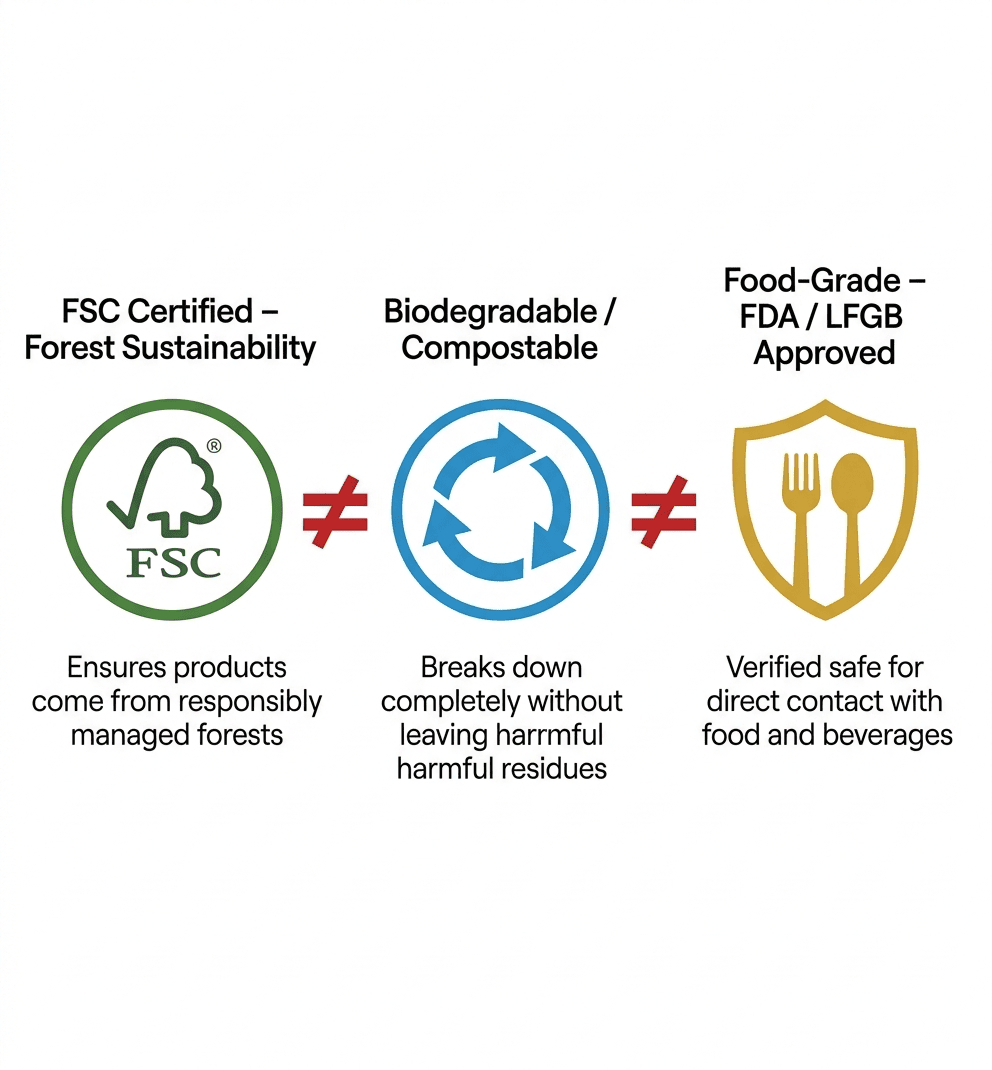
No, FSC and biodegradable certificates are not enough for food safety. FSC confirms the paper comes from responsible forests, while "biodegradable" describes how it breaks down. Neither proves the paper is free from chemicals that are unsafe for people to consume.
This is one of the most common and dangerous mistakes I see new buyers make. They come to us with a sample from another supplier, proud that it's "FSC-certified," and they assume that means it's good to go. But these certifications measure completely different things. FSC (Forest Stewardship Council) is a fantastic standard for environmental sustainability5. It tells you the wood was harvested in a way that protects forests, animals, and local communities. But it tells you nothing about the chemicals used to turn that wood into paper. Similarly, a "biodegradable" or "compostable" label just tells you what happens to the straw after you throw it away. It doesn't guarantee the straw is safe while it's sitting in your drink. Think of it this way: wood from an FSC forest is great, but you wouldn't chew on a piece of pressure-treated lumber made from it. That's because the treatment chemicals are toxic. The same logic applies here. For a paper straw, you must always ask for the specific food-contact test reports, like FDA 21 CFR for the USA or LFGB for the European market6. These are the documents that prove safety.
Saving money on raw materials feels like a smart move. But what if that saving leads to much bigger costs later on? It is a huge gamble for your business.
Using regular pulp exposes your business to massive risks. This includes product recalls, failed customs inspections, legal action, and permanent damage to your brand. The small amount you save upfront is nothing compared to the potential for catastrophic business failure.
Let's be very direct about the potential consequences. I once had a new client come to us in a panic. They had tried to save money by sourcing cheap paper from an unverified supplier for their first big production run. Their customer, a major distributor, rejected the entire shipment because the straws had a strange chemical smell. They lost the contract, had to destroy thousands of dollars of inventory, and nearly went out of business. This is not a rare story.
Here are the key risks you take when you use non-food-grade paper:
Choosing food-grade pulp for paper straws is not an expense; it's an investment in safety, compliance, and your brand's future. Always verify food-contact certifications for your specific market.
"An overview of paper and paper based food packaging materials", https://pmc.ncbi.nlm.nih.gov/articles/PMC6801293/. Food-contact paper manufacturing is regulated under frameworks that specify permissible substances, production hygiene standards, and contaminant limits, though specific requirements vary by jurisdiction. Evidence role: mechanism; source type: government. Supports: the regulatory framework governing food-contact paper manufacturing processes. Scope note: This describes the regulatory structure rather than proving all food-grade pulp manufacturers uniformly achieve contamination-free production. ↩
"Inventory of Food Contact Substances Listed in 21 CFR - FDA", https://www.fda.gov/food/packaging-food-contact-substances-fcs/inventory-food-contact-substances-listed-21-cfr. The FDA regulates food-contact substances under 21 CFR, while Germany's LFGB (Lebensmittel- und Futtermittelgesetzbuch) establishes requirements for materials intended to contact food, each with distinct testing protocols and permissible substance lists. Evidence role: definition; source type: government. Supports: the regulatory frameworks FDA and LFGB represent for food-contact materials. ↩
"An overview of paper and paper based food packaging materials", https://pmc.ncbi.nlm.nih.gov/articles/PMC6801293/. Food-contact paper manufacturers typically favor virgin fibers because recycled paper may contain residual contaminants from previous uses, including inks, adhesives, and mineral oils, though some recycled materials can meet food-safety standards with appropriate decontamination processes. Evidence role: expert_consensus; source type: research. Supports: the preference for virgin fibers in food-contact paper due to contamination concerns. Scope note: This reflects general industry practice rather than an absolute regulatory requirement in all jurisdictions. ↩
"Food packaging from recycled papers: chemical, physical, optical ...", https://pmc.ncbi.nlm.nih.gov/articles/PMC9576889/. Studies have identified various contaminants in recycled paper including mineral oil hydrocarbons, phthalates, photoinitiators, and residual printing inks, some of which can migrate from packaging to food products under certain conditions. Evidence role: mechanism; source type: research. Supports: the types of contaminants found in recycled paper and their potential migration to food. ↩
"Forest Stewardship Council", https://en.wikipedia.org/wiki/Forest_Stewardship_Council. The Forest Stewardship Council certification verifies that forest products come from responsibly managed forests based on environmental, social, and economic principles, but does not address chemical safety of processed products. Evidence role: definition; source type: institution. Supports: the scope and purpose of FSC certification. ↩
"Inventory of Food Contact Substances Listed in 21 CFR - FDA", https://www.fda.gov/food/packaging-food-contact-substances-fcs/inventory-food-contact-substances-listed-21-cfr. FDA 21 CFR governs food-contact substances in the United States, while LFGB is a German national law; the European Union has its own framework regulation (EC) No 1935/2004 for food-contact materials that applies across member states. Evidence role: general_support; source type: government. Supports: the jurisdictional scope of these food-contact regulations. Scope note: LFGB is specifically German law, not the overarching European standard, though it is commonly referenced for European market compliance. ↩
"Food Packaging and Chemical Migration: A Food Safety Perspective", https://pmc.ncbi.nlm.nih.gov/articles/PMC12096275/. Sensory defects in paper products can result from residual lignin, extractives, processing chemicals, microbial contamination, or volatile organic compounds, which may become more noticeable when paper contacts liquids and releases these substances. Evidence role: mechanism; source type: research. Supports: the chemical basis for sensory defects in paper products. ↩
"Evaluation of paper straws versus plastic straws - BioResources", https://bioresources.cnr.ncsu.edu/resources/evaluation-of-paper-straws-versus-plastic-straws-development-of-a-methodology-for-testing-and-understanding-challenges-for-paper-straws/. Paper straw durability in liquids depends on fiber quality, refining degree, wet-strength additives, and barrier coatings; virgin fibers typically provide better strength properties than lower-grade recycled fibers, though wet-strength performance is primarily determined by chemical additives and manufacturing process. Evidence role: mechanism; source type: research. Supports: the factors affecting paper straw performance in liquids. Scope note: Fiber source is one of multiple factors affecting straw performance, not the sole determinant. ↩
"Food packaging from recycled papers: chemical, physical, optical ...", https://pmc.ncbi.nlm.nih.gov/articles/PMC9576889/. Paper products not intended for food contact may contain residual processing chemicals, including chlorinated compounds from bleaching, heavy metals from certain pigments or recycled content, and various organic contaminants, though concentrations vary widely by manufacturing process. Evidence role: mechanism; source type: research. Supports: the presence of potentially harmful substances in paper not manufactured for food contact. Scope note: This describes potential contaminants rather than proving all non-food-grade paper contains harmful levels of these substances. ↩
"Food Packaging & Other Substances that Come in Contact with Food", https://www.fda.gov/food/food-ingredients-packaging/food-packaging-other-substances-come-contact-food-information-consumers. Major markets including the European Union, United States, Canada, and other developed nations maintain regulatory frameworks requiring food-contact materials to undergo safety assessments and meet migration limits for substances that could transfer to food. Evidence role: general_support; source type: government. Supports: the existence of regulatory frameworks for food-contact materials in developed markets. ↩
"Importing Human Foods - FDA", https://www.fda.gov/industry/importing-fda-regulated-products/importing-human-foods. Customs authorities in regulated markets have the authority to inspect imported food-contact articles for compliance documentation and can detain or refuse entry to shipments lacking required certifications, though enforcement intensity varies by jurisdiction and product risk level. Evidence role: mechanism; source type: government. Supports: the authority of customs to enforce food-contact material regulations. Scope note: This describes regulatory authority rather than providing statistics on rejection frequency. ↩