Struggling to pick the right paper straw? Choosing the wrong one can lead to customer complaints and unnecessary waste, hurting your business’s reputation and bottom line[^1].
The best paper straw size depends on your specific drink’s thickness, cup height, and any add-ins like ice or boba. The key is to match the straw’s diameter for flow, length for reach, and quality for durability to ensure a positive customer experience.
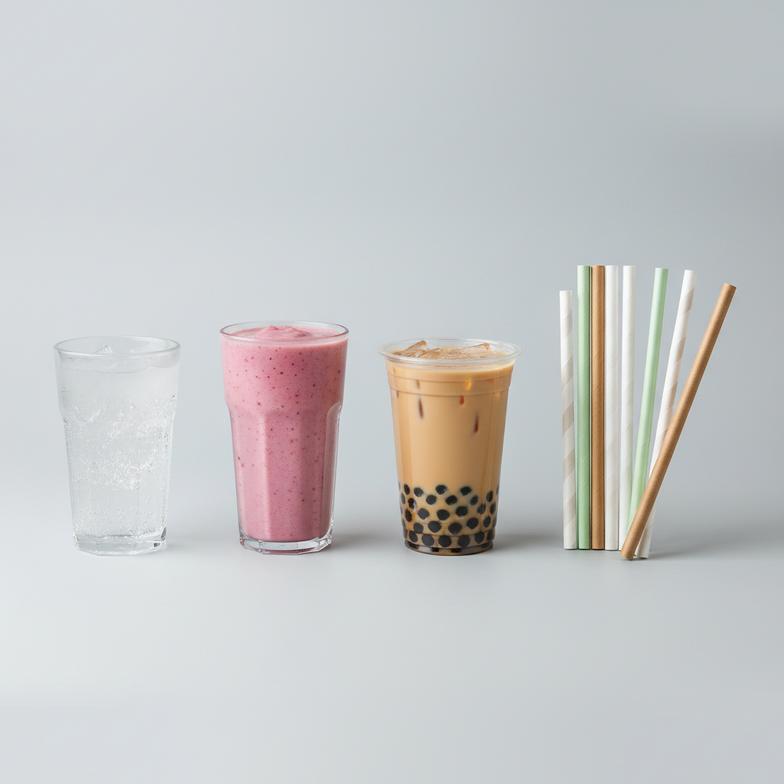
I’ve talked to hundreds of cafe and restaurant owners. A common theme is the search for a simple, one-size-fits-all solution for paper straws. Many buyers hope to find a universal chart that tells them exactly which straw to use for which drink. While I wish it were that easy, relying on a generic chart is one of the biggest mistakes you can make. The truth is, choosing a paper straw is a business decision, not just a supply order. It requires a bit more thought, but getting it right saves you money and headaches. Let’s walk through how to think about it correctly.
You found a size chart online, but it feels too simple. You’re afraid that following it will lead to problems you can’t foresee, and you are right to be cautious.
A simple chart fails because it ignores key variables like ice type, toppings, and cup dimensions. For example, a single "iced tea" could require three different straws depending on whether it has crushed ice, fruit pulp, or is served in a tall glass.
A common question we receive from new cafe owners is, "Just send me your standard chart." But the reality is that the "standard" is different for every business. A chart might tell you to use a 6mm straw for iced tea. But what if your iced tea is served with a large amount of crushed ice? That 6mm straw will get clogged instantly, frustrating your customer. What if you add thick fruit pulp? Same problem. The chart doesn’t account for the reality of your menu.
The thickness, or viscosity, of a drink is the first factor that makes simple charts fail. A watery soda flows easily through a narrow straw, but a thick, creamy milkshake needs a much wider opening. But it gets more complex.
Simple charts almost never account for the most popular drink additions. This is where many businesses get into trouble, especially with the rise of bubble tea and loaded fruit drinks[^3].
| Add-in | Common Problem | Recommended Straw Diameter |
|---|---|---|
| Boba Pearls | Block standard straws completely. | 12mm is the industry standard[^4]. |
| Fruit Pulp | Clogs narrow and medium straws. | 8mm or 10mm, depending on pulp size. |
| Thick Syrups | Can stick and block narrow straws. | 8mm is a safe starting point. |
Finally, a chart doesn’t know what kind of cup you use. A straw must be tall enough to be used comfortably but not so tall that it’s unstable. The length should be about 2-5 cm (1-2 inches) taller than the cup’s height[^5]. Furthermore, the hole in your cup lid determines the maximum straw diameter you can use. Trying to force a 12mm boba straw through a standard 8mm lid opening just creates a mess.
Feeling overwhelmed by specs like diameter and length? You just want a simple way to make the right choice for your business without becoming a straw manufacturing expert.
Think of it in three dimensions: Diameter for flow, Length for reach, and Build Quality for durability. Diameter controls what can pass through, Length ensures it reaches the drink, and Build Quality makes sure it lasts long enough for the customer to finish.
Instead of looking for a perfect chart, we teach our customers to use a simple 3D framework. This approach turns you into an informed buyer and ensures you get the right product for your needs. It breaks the decision down into three simple questions about how the straw will function.
Diameter is the most critical dimension. It controls how easily the drink flows to the customer. Choosing the wrong diameter is the fastest way to create a bad experience.
A straw that is too short is useless. A straw that is too long is awkward and can easily tip a cup over. The rule of thumb is simple: the straw should be 2-5 cm (1-2 inches) taller than the top of the cup. Measure your most-used cup sizes and order accordingly. Common lengths are 197mm (7.75") for standard glasses and 210mm (8.25") or longer for taller tumblers.
Not all paper straws are made equal. The biggest fear for any business switching to paper is the "soggy straw." This is determined by the build quality. A good quality paper straw should last for hours in a cold drink[^6]. We ensure our straws are made with 3 or 4 layers of food-grade kraft paper, bonded with a safe adhesive. This construction is what prevents the straw from getting soft and collapsing. When you ask a supplier about quality, ask them about the number of paper layers (plies). A 2-ply straw will always be weaker than a 3-ply or 4-ply straw[^7].
Saving a few cents on the wrong straws seems smart. But what if that choice leads to bad reviews online and customers walking away? The hidden costs can be huge.
The wrong straw size directly impacts your bottom line. It can lead to negative online reviews from frustrated customers, increased waste as people take multiple straws, and higher inventory costs from stocking too many different, unused types.
I once spoke to a cafe chain’s procurement manager who switched to a cheaper, narrower straw for their signature smoothies to save a fraction of a cent per unit. Within a month, their social media pages were filled with complaints about "unusable straws." They quickly realized that the small savings on procurement were costing them much more in brand damage and lost customers. The cost of a straw is not just its purchase price.
A paper straw has one job: to transfer a drink from the cup to the customer’s mouth. If it fails, the entire experience is ruined.
When a straw fails, what does a customer do? They grab another one. And maybe another one after that. Suddenly, your "one straw per drink" cost has doubled or tripled. This waste adds up quickly across hundreds or thousands of customers per day. It also creates more cleanup for your staff and puts an unnecessary strain on your supply.
Some business owners try to solve the problem by ordering one of every straw size available. This is also a mistake. You end up with cash and storage space tied up in boxes of straws that rarely get used. The goal is to identify the 2-3 key sizes that serve 95% of your menu. This streamlines your ordering process, reduces your inventory holding costs[^9], and simplifies operations for your staff. For most cafes, a 6mm straw for coffees/teas and an 8mm or 10mm straw for thicker drinks is a perfect combination.
Ready to order straws but don’t know how to describe your needs? You worry about miscommunication with the supplier and getting the wrong product, wasting time and money.
To get the perfect straws, give your supplier a clear picture. List your main drinks, provide your cup sizes, and describe the customer experience you want. An informed buyer always gets better results and a better price.
As a supplier, the more information you give me, the better I can help you. We aren’t just order takers; we are solution providers. Helping you succeed helps us succeed. Before you contact a supplier, prepare a short brief. This makes you look professional and ensures you get exactly what you need.
Don’t just say you need straws. Be specific about what they will be used for. Make a simple list of your top 5-10 beverages.
We need to know what the straw is going into. The right straw for a small 12oz cup is different from one for a large 24oz tumbler.
| Information Needed | Example | Why it’s important |
|---|---|---|
| Cup Volume | 16 oz / 473 ml | Helps estimate general size. |
| Cup Height | 14 cm / 5.5 inches | Determines the required straw length. |
| Lid Opening | 8mm hole | Determines the maximum straw diameter. |
Finally, tell us about the experience you want to create. Are you a high-volume fast-food restaurant where speed is key? Or are you a high-end cafe where a premium feel is important? Do you need straws individually wrapped for hygiene[^10]? Do you want your logo printed on the wrapper or the straw itself? Providing this context allows us to recommend a product that not only functions perfectly but also enhances your brand. A customer who provides this level of detail is a partner, and we work harder for our partners.
Choosing the right paper straw is a strategic choice. It protects your brand reputation, eliminates waste, and ensures every customer has a great experience with your drinks.
[^1]: "The impact of perceived value on brand image and loyalty – PMC", https://pmc.ncbi.nlm.nih.gov/articles/PMC11484097/. A study or report from a business research institution could demonstrate the return on investment (ROI) of a positive customer experience, showing that companies that focus on optimizing all touchpoints tend to have higher customer loyalty, better brand perception, and stronger financial performance. Evidence role: general_support; source type: research. Supports: The business principle that negative customer experiences, even on small touchpoints, can damage brand reputation and have a measurable negative financial impact.. Scope note: The source would likely discuss the principle in general, not specifically in the context of paper straws. [^2]: "The effect of different methods of drinking a carbonated beverage on …", https://pubmed.ncbi.nlm.nih.gov/16475452/. A source on fluid dynamics or chemistry could explain the principle of gas escaping a solution (effervescence), noting that a smaller surface area at the top of the liquid column in the straw could slow the rate at which dissolved CO2 comes out of solution, thereby preserving carbonation. Evidence role: mechanism; source type: education. Supports: The physics behind how a narrower opening can reduce the rate of CO2 outgassing from a carbonated beverage.. Scope note: The effect may be minor and dependent on other factors like temperature and sipping rate. [^3]: "Alcoholic Beverage Trends 2026 – Penn State Extension", https://extension.psu.edu/alcoholic-beverage-trends-2026/. A market research report on the global beverage industry could provide statistics on the growth of the bubble tea market, citing its increasing popularity and expansion into new regions, which supports the premise that businesses must increasingly account for its specific needs. Evidence role: statistic; source type: research. Supports: The significant and continued growth of the bubble tea and customizable beverage market.. Scope note: Market growth figures can vary between reports and are often projections. [^4]: "ALINK 100 Extra Large Plastic Bubble Tea Smoothie Straws, 1/2 …", https://www.amazon.com/ALINK-Plastic-Bubble-Smoothie-Milkshake/dp/B06XV3P2N2. A report or guide from a food service or beverage industry association could confirm that 12mm diameter straws are the standard for accommodating typical tapioca pearls, which are often around 8-10mm in diameter. Evidence role: general_support; source type: institution. Supports: That 12mm is the widely accepted and used diameter for straws intended for bubble tea with tapioca pearls.. Scope note: The ‘standard’ can vary by region or specific boba supplier. [^5]: "[PDF] Ergonomics for the Food Services Industry Fact Sheet", https://www.tdi.texas.gov/pubs/videoresource/fsergofood.pdf. A design or food service guide could support this by explaining that a straw 2-5 cm taller than the cup provides sufficient length for comfortable sipping without requiring the user to bend over, while not being so long as to be unstable and risk tipping the container. Evidence role: general_support; source type: education. Supports: The ergonomic and practical reasons for a straw needing to be a certain length relative to the cup.. Scope note: This is a general guideline, and optimal length can be influenced by personal preference or specific cup designs. [^6]: "Evaluation of paper straws versus plastic straws – BioResources", https://bioresources.cnr.ncsu.edu/resources/evaluation-of-paper-straws-versus-plastic-straws-development-of-a-methodology-for-testing-and-understanding-challenges-for-paper-straws/. A study or independent product testing report could provide data on the longevity of multi-ply paper straws in various liquids, showing that well-constructed straws can remain functional for two hours or more, supporting the claim of durability. Evidence role: statistic; source type: research. Supports: That high-quality paper straws can maintain their structural integrity in a cold beverage for several hours.. Scope note: Durability is highly variable and depends on the specific straw’s construction, the temperature and acidity of the drink, and user behavior (e.g., chewing). [^7]: "The influence of the composition of pulp and the number of layers on …", https://bioresources.cnr.ncsu.edu/resources/the-influence-of-the-composition-of-pulp-and-the-number-of-layers-on-the-strength-properties-of-multi-layer-papers-intended-for-the-production-of-corrugated-paperboard/. A source from materials science or paper engineering could explain that laminating multiple layers of paper (plies) with adhesive creates a composite structure with significantly greater rigidity and resistance to compressive and bending forces compared to a single or fewer-ply structure of equivalent thickness. Evidence role: mechanism; source type: paper. Supports: The mechanical principle that increasing the number of bonded layers in a paper structure increases its strength and resistance to deformation.. Scope note: While generally true, overall strength also depends on the quality of the paper, the adhesive used, and the manufacturing process. [^8]: "National Strategy to End the Use of Paper Straws – The White House", https://www.whitehouse.gov/fact-sheets/2025/03/a-report-of-the-domestic-policy-council/. A consumer survey or market research report analyzing public opinion on plastic straw alternatives could provide data showing that structural failure (i.e., becoming soggy or collapsing) is the most prevalent complaint among users of paper straws. Evidence role: statistic; source type: research. Supports: That lack of durability and ‘sogginess’ is the most frequently cited issue by consumers regarding paper straws.. Scope note: Consumer complaints can be influenced by media narratives and may change over time as product quality improves. [^9]: "Carrying cost – Wikipedia", https://en.wikipedia.org/wiki/Carrying_cost. A textbook or guide on business management or supply chain logistics could define inventory holding costs as the sum of expenses related to storing unsold inventory, including storage space, insurance, and the cost of capital tied up in stock, confirming that reducing the variety of items held (SKUs) is a standard strategy for minimizing these costs. Evidence role: definition; source type: education. Supports: The definition and components of inventory holding costs and the principle that reducing stock keeping units (SKUs) lowers these costs.. [^10]: "National Strategy to End the Use of Paper Straws – The White House", https://www.whitehouse.gov/fact-sheets/2025/03/a-report-of-the-domestic-policy-council/. A food safety code or guidance document from a public health organization (like the FDA or a local health department) could specify that single-use items like straws must be protected from contamination, which is typically achieved by keeping them in their original wrapping or providing them in a sanitary, hands-free dispenser. Evidence role: expert_consensus; source type: government. Supports: The food safety rationale for using individually wrapped or hygienically dispensed straws.. Scope note: The specific requirement may vary by jurisdiction, and a sanitary dispenser for unwrapped straws may be considered an equivalent measure.