
Worried about soggy, unraveling straws ruining your brand? It’s a common fear for buyers[^1], but the solution is simpler than you might think.
snippet paragraph: To avoid paper straw defects, shift your focus from the product to the supplier’s process. Understand that defects are symptoms of deeper issues in materials, manufacturing, or storage[^2]. The key is asking the right questions to diagnose the root cause before you buy.
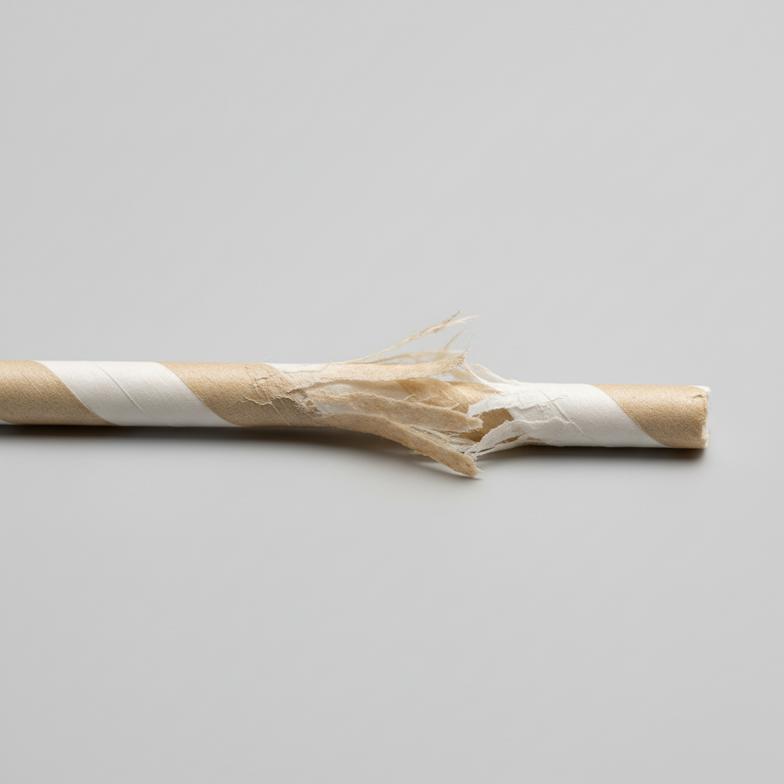
Transition Paragraph: Many buyers come to us with a list of technical specs they think will guarantee quality. But based on our experience handling hundreds of inquiries, we’ve found that this approach often misses the real problem. The best way to ensure quality isn’t just about the straw—it’s about understanding how it’s made and who is making it. Let’s explore how to become a smarter buyer and protect your business.
leading paragraph: Frustrated by straws falling apart in drinks? This common complaint can damage your reputation and lead to customer dissatisfaction. What’s the real cause behind this?
snippet paragraph: Sogginess and unraveling often point to a mismatch between the paper, glue, and manufacturing process, not just "bad paper." It could be incorrect glue application, poor curing, or the wrong paper weight[^3]. A good supplier can explain their specific combination.
Dive deeper Paragraph: A frequent question we get from buyers is about the quality of the paper. They assume that if a straw gets soggy, the paper must be cheap or low-grade. While paper quality matters, it’s only one piece of the puzzle. In our factory, we’ve learned that the interaction between paper, glue, and machine settings is what truly determines a straw’s durability. A defect is a symptom, and your job as a buyer is to trace it back to the root cause. When a customer reports an issue, we don’t just send a new batch; we investigate the cause.
Thinking like a detective will help you find a better supplier. Here’s how you can connect common issues to their likely origins and what to ask.
| Visible Defect (Symptom) | Potential Root Cause (Disease) | Question for Supplier |
|---|---|---|
| Gets soggy fast | Incorrect paper weight (GSM), wrong glue type for paper, insufficient curing time.[^4] | "What is your process for matching glue type and curing time to the paper you use for different applications?" |
| Unravels at the seam | Weak glue adhesion, improper winding tension on the machine, glue applied too thinly.[^5] | "Can you show me your QC checks for spiral integrity and seam strength, especially during a long production run?" |
| Has a chemical odor | Non-food-grade glue or ink, mold from improper storage or shipping.[^6] | "What specific materials do you use for your glue and ink, and can you provide the MSDS and food-contact safety reports?" |
leading paragraph: A customer complains their straw didn’t last. Is it a bad batch, or was it the wrong straw for their slushie, smoothie, or hot coffee?
snippet paragraph: Many "defects" are actually a mismatch between the straw’s design and its use case. A standard 6mm cold-drink straw will fail in a thick smoothie or a hot latte[^7]. The first step to quality is defining the exact application for the straw.
Dive deeper Paragraph: We often see buyers order a "standard" paper straw without thinking about how it will be used. Then, they are surprised when it doesn’t perform well in a thick, icy milkshake or a steaming cup of coffee. This isn’t a defect; it’s a mismatch of requirements. The most important step in sourcing is to clearly define your use case first. A good supplier should be more like a consultant. When a new customer contacts us, our first questions are always about the drink. What is the liquid? What is its temperature? Is it carbonated? How long does the straw need to last? If a supplier isn’t asking you these questions, they are focused on selling a product, not providing a solution.
Before you even look at a spec sheet, you need to know exactly what you need. This helps you and the supplier choose the right product.
| Use Case | Key Requirement | Likely Straw Specification |
|---|---|---|
| Iced Coffee, Soda, Water | Standard durability (30-60 mins)[^8] | 6mm diameter, 3-ply paper |
| Thick Smoothie, Milkshake | High rigidity, wider diameter, won’t collapse | 8mm-12mm diameter, 4-ply paper[^9] |
| Hot Beverages (Coffee, Tea) | Heat resistance, glue that doesn’t soften | Special heat-resistant glue[^10], 4-ply paper |
| Bubble Tea (Boba) | Extra wide diameter, sharp tip for piercing film | 12mm+ diameter, often with an angled cut |
leading paragraph: You have a spec sheet with paper weight, plies, and dimensions. Is that enough to guarantee quality? We’ve seen many buyers get burned by this assumption.
snippet paragraph: A spec sheet is just a promise. A reliable supplier’s process control, consistency, and transparency are the real guarantees of quality. Your most important sourcing decision is choosing a partner who can prove their manufacturing discipline, not just one who meets a checklist.
Dive deeper Paragraph: Based on our after-sales support experience, we’ve found that the problem often isn’t the paper or the glue itself, but the consistency of the manufacturing process. Any factory can produce a perfect sample. The real challenge is making the millionth straw as good as the first[^11]. This is where your choice of supplier becomes the single most important factor. A spec sheet can’t tell you if the machine operator is well-trained, if the glue is applied evenly on every straw, or if the finished products are stored correctly. We encourage buyers to move beyond the spec sheet and ask process-oriented questions. The best suppliers aren’t afraid to show you how they work.
Focus on these areas to evaluate a supplier’s true capability:
leading paragraph: Suppliers promise "food-grade glue" and "FSC-certified paper." But how can you be sure these claims translate into a durable, safe straw for your customers every time?
snippet paragraph: Don’t get trapped by technical jargon. Instead of just accepting a claim, ask for evidence and context. A trustworthy supplier will welcome questions about their process and provide documentation to back up their claims, showing how their specs translate into real-world performance.
Dive deeper Paragraph: Technical specifications without context can be a trap. For example, "food-grade glue" is a basic requirement, not a mark of high quality. The real question is whether it’s the right food-grade glue for the specific paper and machine speed they are using. That’s a process question, not just a spec sheet item. As a solution provider with our own factory, we know that the best materials can fail if they aren’t used correctly. Your goal as a buyer isn’t to become an engineer but to learn how to ask smarter questions that push suppliers to provide evidence for their claims. A supplier’s willingness to discuss their process in detail is a much better indicator of quality than a long list of technical promises.
Change your questions to get more meaningful answers:
| Instead of Asking This… | Try Asking This… | Why It’s Better |
|---|---|---|
| "Is your glue food-grade?" | "Can you provide the food-contact safety documents for the specific glue and ink used in my straws?" | This asks for proof, not just a "yes" or "no." |
| "What is the paper GSM?" | "How do you determine the right paper GSM and ply count for my specific application, like a thick smoothie?" | This tests their expertise and consultative approach. |
| "Are you certified?" | "Can you share a recent QC report and your batch tracking protocol for an order similar to mine?" | This moves beyond a static certificate to evidence of ongoing quality management. |
Avoiding paper straw defects is about building a smart sourcing process. Focus on the supplier’s process, define your use case, and ask the right questions to build a reliable partnership.
[^1]: "Evaluation of paper straws versus plastic straws – BioResources", https://bioresources.cnr.ncsu.edu/resources/evaluation-of-paper-straws-versus-plastic-straws-development-of-a-methodology-for-testing-and-understanding-challenges-for-paper-straws/. A source could provide survey data or market research showing that a significant portion of consumers have negative experiences with paper straws, which in turn affects their perception of the brand that provided them. Evidence role: statistic; source type: research. Supports: The source should provide data or analysis on consumer dissatisfaction with paper straws and the potential for this to negatively affect the reputation of food and beverage establishments.. [^2]: "Statistical process control – Wikipedia", https://en.wikipedia.org/wiki/Statistical_process_control. A source could explain the concept of root cause analysis, a foundational principle in quality management, which posits that production defects are typically symptoms of systemic issues in processes, materials, or systems. Evidence role: general_support; source type: education. Supports: The source should explain the principle of root cause analysis in a manufacturing context, supporting the idea that visible defects are often symptoms of underlying process or material issues.. Scope note: The source would support the general principle of quality management, not its specific application to paper straws. [^3]: "Evaluation of paper straws versus plastic straws – BioResources", https://bioresources.cnr.ncsu.edu/resources/evaluation-of-paper-straws-versus-plastic-straws-development-of-a-methodology-for-testing-and-understanding-challenges-for-paper-straws/. A source could detail the mechanics of paper straw manufacturing, explaining how insufficient adhesive, improper curing, or a mismatch between paper basis weight and adhesive can lead to delamination and structural failure when wet. Evidence role: mechanism; source type: paper. Supports: The source should describe the manufacturing process for spiral-wound paper tubes (like straws) and detail how factors like adhesive application, curing time, and paper properties affect the final product’s structural integrity and water resistance.. [^4]: "Impact of Curing Time and Temperature on Bond Performance of …", https://pmc.ncbi.nlm.nih.gov/articles/PMC12030511/. A source could provide research demonstrating the relationship between paper basis weight (GSM), adhesive properties, and curing processes on the liquid resistance and durability of paper products, confirming these as critical factors in preventing sogginess. Evidence role: mechanism; source type: research. Supports: The source should provide research on how paper properties (like grammage/GSM) and adhesive curing affect the water resistance and structural integrity of paper-based food-contact items.. [^5]: "[PDF] The Science of Winding Paper Rolls – BioResources", https://bioresources.cnr.ncsu.edu/wp-content/uploads/2020/03/1993.2.855.pdf. A source could explain that in the manufacturing of spiral-wound paper tubes, factors such as adhesive viscosity, application volume, and the tension of the paper plies during winding are critical for creating a strong, permanent seam bond. Evidence role: mechanism; source type: paper. Supports: The source should describe the physics of creating spiral-wound tubes, explaining how adhesive bond strength and machine parameters like winding tension are critical for maintaining seam integrity.. [^6]: "Food Packaging and Chemical Migration: A Food Safety Perspective", https://pmc.ncbi.nlm.nih.gov/articles/PMC12096275/. A source from a food safety agency could confirm that odors in food packaging can indicate the presence of unauthorized substances (from non-food-grade materials) or microbial contamination, both of which pose potential health risks. Evidence role: general_support; source type: government. Supports: The source should discuss regulations and safety concerns related to food-contact materials, including the potential for chemical migration from non-compliant adhesives/inks and the risk of microbial growth like mold due to improper humidity control during storage and transport.. [^7]: "Evaluation of paper straws versus plastic straws – BioResources", https://bioresources.cnr.ncsu.edu/resources/evaluation-of-paper-straws-versus-plastic-straws-development-of-a-methodology-for-testing-and-understanding-challenges-for-paper-straws/. A source could present findings from a study on paper straw performance, demonstrating that exposure to heat (as in a latte) accelerates water absorption and weakens adhesives, while high viscosity (as in a smoothie) creates suction forces that can cause a standard straw to collapse. Evidence role: case_reference; source type: research. Supports: The source should provide data from testing paper straws under various conditions, showing reduced structural integrity and faster failure times when exposed to high viscosity liquids or elevated temperatures.. [^8]: "Evaluation of paper straws versus plastic straws – BioResources", https://bioresources.cnr.ncsu.edu/resources/evaluation-of-paper-straws-versus-plastic-straws-development-of-a-methodology-for-testing-and-understanding-challenges-for-paper-straws/. A source could cite an industry testing standard or a summary of third-party lab results that show the average time-to-failure for a typical 3-ply paper straw in a room-temperature aqueous solution falls within the 30-to-60-minute range. Evidence role: statistic; source type: institution. Supports: The source should reference an industry standard or a comprehensive product test that establishes a typical functional lifespan for standard paper straws in cold beverages.. Scope note: Performance can vary widely based on manufacturing quality and specific beverage composition; this range represents a general benchmark, not a guarantee. [^9]: "Impact of 5-Ply toilet paper configuration on its mechanical and …", https://bioresources.cnr.ncsu.edu/resources/impact-of-5-ply-toilet-paper-configuration-on-its-mechanical-and-absorption-properties/. A source could explain that, according to principles of structural mechanics, increasing the number of plies in a composite tube increases its rigidity and resistance to collapse under suction, making a 4-ply construction suitable for use with high-viscosity liquids like smoothies. Evidence role: mechanism; source type: paper. Supports: The source should explain the mechanical engineering principle that increasing the number of layers (plies) in a laminated paper tube increases its wall thickness and moment of inertia, thereby enhancing its resistance to bending and buckling.. [^10]: "Effects of treatment temperature on properties of starch-based …", https://bioresources.cnr.ncsu.edu/resources/effects-of-treatment-temperature-on-properties-of-starch-based-adhesives/. A source could describe how the adhesives used in paper food packaging are selected based on their thermal properties, noting that applications involving hot liquids require formulations with a higher glass transition temperature to prevent the adhesive from softening and failing. Evidence role: mechanism; source type: research. Supports: The source should explain that many common adhesives have a glass transition temperature that can be exceeded by hot beverages, causing them to soften and lose bond strength. It should also mention the existence of formulations designed for higher thermal stability.. [^11]: "Statistical process control – Wikipedia", https://en.wikipedia.org/wiki/Statistical_process_control. A source could explain the manufacturing principle of process capability, which focuses on designing and monitoring a system to ensure that output remains within specification limits over time, thus addressing the challenge of maintaining quality from the first unit to the millionth. Evidence role: definition; source type: institution. Supports: The source should define or explain the concept of process capability (Cpk) or statistical process control (SPC), which are methodologies used to ensure consistent quality over long production runs.. Scope note: The source would provide general manufacturing theory, not specific data on paper straw production.