
Many buyers start their search for a paper straw supplier by comparing the price per thousand straws. From my side of the desk, I’ve seen that the most expensive mistakes rarely come from the unit price. They come from the details missing from the quotation—the carton volume, the material suitability for a specific drink, and the moisture protection needed for a long sea journey.
Judging a supplier on price alone is a risk. Overseas buyers should check a China paper straw supplier’s quotation transparency, their process for matching specs to your specific drink application, their sample testing requirements, and their ability to provide complete carton data to accurately calculate landed cost.
A good supplier’s job isn’t just to sell you a straw; it’s to make sure you’re buying the right one. Here’s what we check on our end, and what you should be looking for.
When a buyer sends an inquiry that just says, "Please quote 1 million paper straws," it’s a sign that they are focused only on price. A low-quality supplier will jump at this and send back a low price. A professional supplier will hit the brakes and ask questions.
The first thing we ask isn’t "how many do you need?" but "what drink will it be used for?" Is it for watery soda, thick milkshakes, or boba tea with pearls? What is the height and opening of the cup? Is there a tall lid? The answers change everything about the straw’s required length, diameter, and strength.
A supplier who just provides a price without knowing your application is either inexperienced or doesn’t care if the product actually works for your customers. We refuse to quote blindly because we know a standard 6mm soda straw sent to a boba tea shop is a guaranteed product failure and a future quality dispute. We slow the process down at the start to get the specifications right, which prevents costly mistakes later.
One of the most common mistakes I see is buyers comparing two quotations based only on the unit price per straw. This is a major blind spot. Your real cost isn’t the price of the straw; it’s the final landed cost of getting a usable, undamaged product to your warehouse.
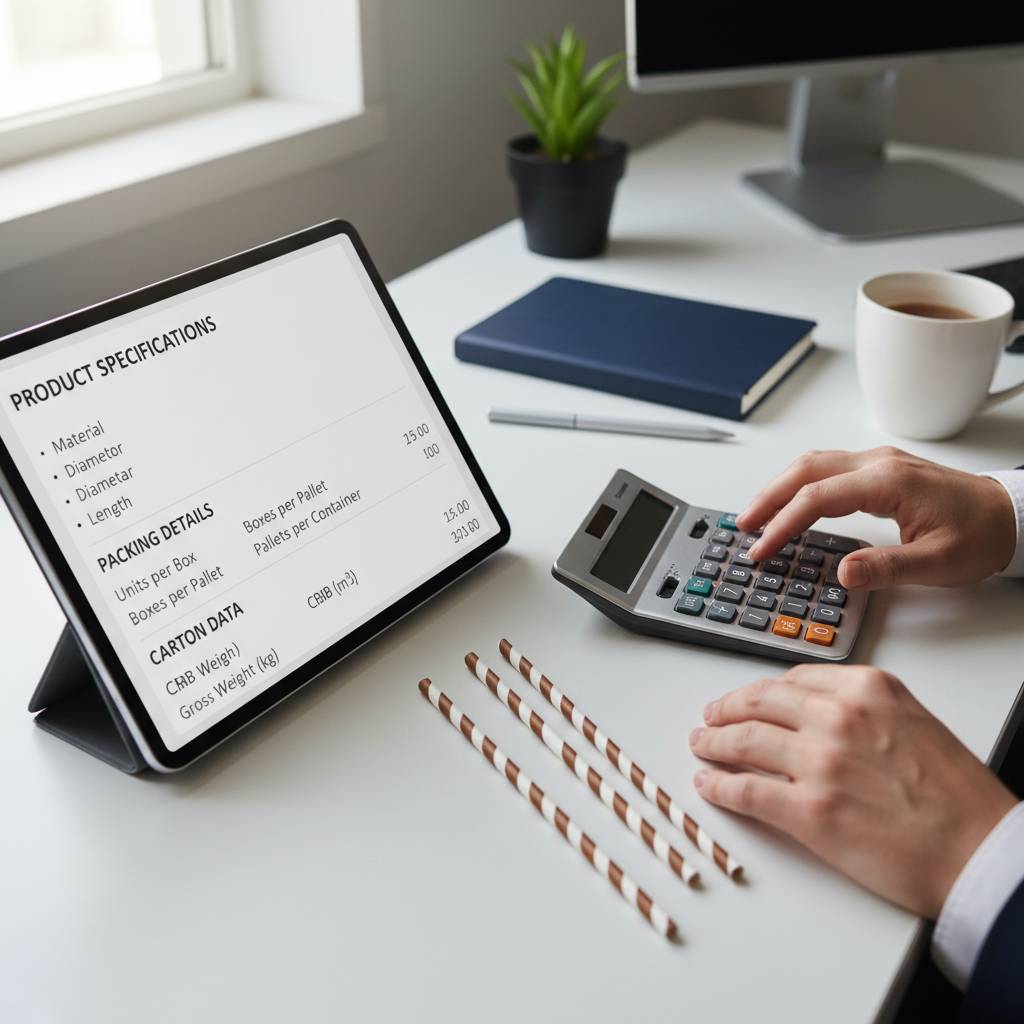
A quotation without carton CBM (cubic meters) and gross weight is incomplete. It’s like showing you the price of a car but hiding the cost to get it home. Buyers get excited by a few cents saved on the unit price, but they don’t realize the supplier is using oversized cartons. This inflates the shipping volume, and you can end up paying far more in ocean freight than you "saved" on the product.
When we build a quotation, we include the straw specifications, the packing method (e.g., 250 pieces per bag, 20 bags per carton), the final carton dimensions, the gross weight, and the total CBM for the order. We do this because we want you to be able to calculate your true landed cost. If a supplier is vague about this data or makes you ask for it multiple times, it’s a red flag that they aren’t thinking about your total cost.
"One-size-fits-all" does not work for paper straws. A straw that’s perfect for water will clog with a smoothie. A straw that works for a short cocktail glass is useless in a tall iced tea cup.
Many buyers, especially those new to paper straws, try to simplify their inventory by ordering one "standard" size. This is a recipe for customer complaints. The difference between a 6mm and an 8mm diameter straw seems tiny, but it’s the difference between a happy customer drinking a milkshake and a frustrated one who can’t get anything through the straw.
Two straws can even have the exact same dimensions but perform completely differently. The number of paper layers, the grade of the paper, and the quality of the bonding glue determine how long the straw will last in a drink. This is why we don’t just confirm a size. We ask about your drink’s thickness, temperature, and acidity to recommend a material structure that will actually perform for the expected drinking time. A cheap, flimsy straw might be fine for a quick sip of water but will disintegrate in an acidic juice or an iced coffee.

Approving a sample based on how it looks and feels when it’s dry is one of the most critical errors a buyer can make. A dry paper straw tells you almost nothing about its performance. It might look perfect, feel strong, and have no odor. The real test is how it holds up in your actual beverages.
We’ve seen buyers approve a beautiful-looking sample, only to get angry calls weeks later when the bulk order straws are turning to mush in their customers’ hands. A responsible supplier wants you to test the samples properly, because a successful test is the best insurance against a failed bulk order.
We always tell our clients: put the sample in your worst-case-scenario drink for 30 minutes, and only then decide if it’s good enough. Test it in your coldest iced coffee, your most acidic fruit juice, or your thickest smoothie. Does it get soggy? Does it develop an odor? Does it bend or collapse when you try to drink? A good supplier will be confident in their samples passing this real-world test. A supplier who rushes you through sample approval may know their product won’t hold up.
Once the straw itself is approved, the work isn’t done. Small misunderstandings about a logo on the wrapper, the number of straws in a retail pack, or the markings on the shipping carton can create big problems.
"Close enough" is not a phrase we use in production. A buyer might assume their logo will be perfectly centered on a custom wrapper, but without a formal artwork proof, it could end up misaligned or in the wrong shade of color. The same goes for packing. Is the straw individually wrapped? Are there inner poly bags inside the master carton to protect against moisture during a long sea voyage? These details must be confirmed.
This is why we have a strict pre-production checklist. We don’t move to bulk production until the buyer has signed off on the final artwork proof, the packing method, and the carton marks. It might seem like an extra step, but it ensures that what the buyer approved is exactly what they will receive. Any supplier who is casual about this final confirmation stage is taking a risk with your money and your brand.
When you’re evaluating a new supplier, don’t just focus on the price. Use these checkpoints to judge their professionalism and ability to deliver a product that works.
Choosing the right partner is about more than finding the lowest price. It’s about finding a supplier who has the right process to prevent problems before they happen.