Struggling with high shipping costs for paper straws? You might be focusing on the wrong numbers, risking your profit margins and product quality on hidden details you can't see.
To truly master logistics, you must shift your focus from the shipping quote to the final landed cost per straw. This means optimizing carton volume, maximizing container space, protecting against moisture, and understanding the complete lead time from production to your warehouse.
When I first started exporting paper straws, I had clients who were laser-focused on one question: "What's the cheapest shipping price?" I get it. Freight is a major expense. But over years of shipping containers worldwide, I've learned a hard lesson that I now share with all my partners: the cheapest freight quote can often be the most expensive mistake. A successful import isn't just about the container arriving; it's about the straws inside arriving in a sellable condition, at a cost that protects your profit. Let's unpack the key areas you need to manage.
Chasing low freight quotes for bulky paper straws? This often leads to surprise costs at the destination, eating into your profits unexpectedly and turning a good deal sour.
A cheap quote often ignores product volume and destination fees. Instead, calculate the landed cost per straw by optimizing carton dimensions and container loading. This reveals your true cost and protects your profit on every unit sold.

Paper straws are a classic "volumetric" product. They are very light but take up a lot of space. Shipping companies charge based on whichever is greater: actual weight or volumetric weight1. For paper straws, it's always volume. This is why a simple freight quote doesn't tell the whole story. The real cost is hidden in how efficiently that volume is used. As a manufacturer, we've learned that a few centimeters saved on a carton can translate into thousands of dollars saved on a full container load2. We help our partners see this by providing all the necessary data to make an informed decision, not just a cheap one.
The first thing we do is move the conversation from freight cost to carton specifications. It's a small shift, but it makes all the difference. When a client asks about shipping, we provide a detailed packing list that includes the carton dimensions (Length x Width x Height), the gross weight, and the net weight. Most importantly, we confirm the number of straws per carton. With this data, you can calculate the CBM (cubic meter) of your shipment and work with your freight forwarder to get an accurate quote. You can also calculate your cost per straw.
For example, a slightly larger, cheaper carton might seem like a good deal, but if it leads to fewer cartons fitting in a container, your cost per straw goes up.
| Specification | Option A (Optimized Carton) | Option B (Standard Carton) |
|---|---|---|
| Carton Dimensions | 55x40x45 cm | 60x45x50 cm |
| Volume (CBM) | 0.099 | 0.135 |
| Cartons per 40HQ | ~680 | ~500 |
| Total Straws (10k/carton) | 6.8 Million | 5.0 Million |
As you can see, a small change in carton design dramatically impacts how many products you can ship, directly affecting your final landed cost per unit.
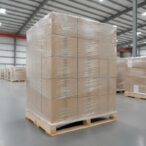
Another critical choice is how to load the container. Pallet loading is faster to load and unload, but the pallets themselves take up valuable space—often reducing container capacity by 10-15%3. Floor loading, or hand-stacking cartons directly onto the container floor, maximizes every inch of space. It takes more labor at your destination to unload, but you ship more product. For high-volume, low-margin items like paper straws, that extra capacity often makes floor loading the more profitable choice. We discuss this trade-off with every client to match the logistics with their business model and warehouse capabilities.
You’ve waited weeks for your shipment. The container arrives, but you open it to find crushed boxes and damp, unusable straws. Now you have a total loss.
Protect your investment by demanding strong packaging. This means using 5-ply export-grade cartons and placing container desiccants to absorb ambient moisture. This ensures your paper straws arrive dry, intact, and ready for your customers.
I've seen firsthand how a long sea journey can ruin paper products. A container traveling from a humid port in Asia through different climate zones to Europe or North America is a tough environment. Temperature changes cause condensation, or "container rain4," which is death to paper. Furthermore, the cartons at the bottom of a stack bear the weight of all the cartons above them. If they are not strong enough, they will collapse. Quality control shouldn't stop when the product leaves the factory floor; it extends all the way to the customer's warehouse. That's why we don't cut corners on packaging—it’s the cheapest insurance you can buy.
Paper is like a sponge; it loves to absorb moisture from the air. This makes straws soft, weak, and prone to mold. It's a problem we take very seriously. For every shipment, especially those with long transit times, we take specific precautions.
When a container is loaded with hundreds of boxes and stacked to the ceiling, the pressure on the bottom layer is immense7. A standard, thin-walled box will crush, not only destroying the straws inside but also creating an unstable stack that can shift and cause a domino effect of damage during transit. We learned early on that our cartons need to be built for the reality of global shipping. The reinforced export cartons we use are designed to withstand stacking pressure, bumps, and movement. It adds a tiny fraction to the cost of the order but has saved our clients from thousands of dollars in damages. This is a detail a trading company might miss, but as a manufacturer who also operates our own paper straw lines, we know what it takes for the product to survive the journey.
You promised your biggest customer a delivery date based on the 25-day transit time you were quoted. But now you're facing angry calls because the stock hasn't even left the factory in China.
Total lead time is not just the sea journey. You must add production, quality control, container booking, customs clearance, and inland transport. We provide a clear production-to-port timeline so you can plan your inventory with confidence.
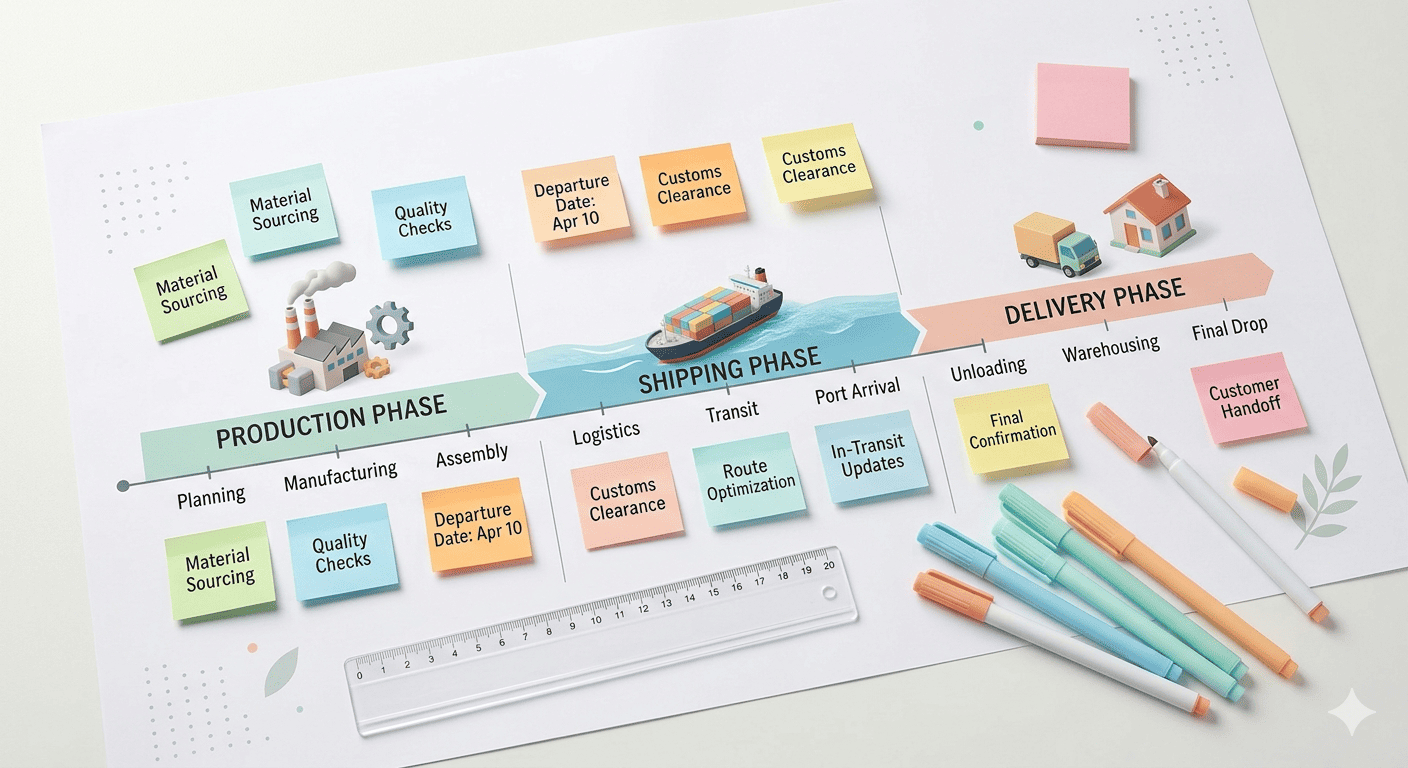
One of the most common mistakes I see new importers make is confusing "shipping time" with "total lead time." A freight forwarder might quote you 30 days of transit on the water, but that clock doesn't start until the container is loaded onto the ship. What about the weeks it takes to produce your custom order, book a vessel, and clear export customs? Forgetting to account for this entire process is the number one cause of broken delivery promises8 and strained customer relationships. That's why we break down the timeline into two distinct phases: production and logistics. We believe transparent communication about timelines is just as important as the quality of the straws themselves.
This phase begins the moment you confirm your order and ends when the goods are packaged and ready to leave our factory. For paper straws, especially custom orders, this is a multi-step process that cannot be rushed.
Once your straws are packed and ready, the next clock starts. This part is often full of variables that are outside of our direct control, which is why planning ahead is so important.
When you add it all up, a 30-day sea transit can easily be part of a 60- to 75-day total lead time. We help our partners see the whole picture so they can manage their inventory and customer expectations accurately.
Mastering logistics is about looking beyond the freight quote. Focus on landed cost, product protection, and realistic timelines to build a profitable and sustainable paper straw business.
"Dimensional weight - Wikipedia", https://en.wikipedia.org/wiki/Dimensional_weight. A source from a logistics guide or encyclopedia can define volumetric weight and explain its application in the freight industry, where charges are based on the greater of the shipment's actual weight or its dimensional weight. Evidence role: definition; source type: encyclopedia. Supports: The source should define volumetric weight (also known as dimensional weight) and explain that carriers use it to charge for the space a package occupies, comparing it to the actual weight to determine the billable weight.. ↩
"[PDF] A Case Study of Container Management at Khalifa bin Salman Port", https://scholar.afit.edu/cgi/viewcontent.cgi?article=8704&context=etd. Research in logistics and supply chain management demonstrates that optimizing secondary packaging dimensions to maximize container fill rates can result in substantial reductions in freight costs per unit. Evidence role: case_reference; source type: research. Supports: The source should provide a case study or analysis demonstrating how optimizing carton dimensions to improve container space utilization leads to significant financial savings in logistics.. Scope note: The exact monetary savings will vary based on the product, route, and freight rates, but the source would support the underlying principle. ↩
"Floor Loading vs. Pallet Loading Containers for B2B Freight - ShipBob", https://www.shipbob.com/blog/floor-loaded-vs-pallet-loaded/. Logistics and shipping industry analyses confirm that the use of pallets, due to their own dimensions and the need for clearance, typically reduces the usable cubic capacity of a container by an estimated 10-15% compared to floor-loading. Evidence role: statistic; source type: institution. Supports: The source should be a logistics or shipping industry publication that quantifies the typical volume lost when using pallets in a standard shipping container compared to floor loading.. ↩
"How to Prevent Moisture in Sea Containers", https://unitload.vt.edu/education/white-papers/3-wp-moisture-in-sea-containers.html. Scientific papers or reports from marine insurers describe the phenomenon of 'container rain,' where moisture inside a container condenses due to temperature changes during transit, potentially causing significant water damage to sensitive goods like paper and cardboard. Evidence role: definition; source type: research. Supports: The source should define 'container rain' or 'container sweat' and explain the mechanism by which temperature differentials during sea transit lead to condensation on the container's interior surfaces, posing a risk to cargo.. ↩
"[PDF] Specifications for Corrugated Paperboard - National Archives", https://www.archives.gov/files/preservation/storage/pdf/corrugated-board.pdf. Packaging engineering resources explain that 5-ply (or double-wall) corrugated board provides significantly greater stacking strength and puncture resistance compared to single-wall (3-ply) board, making it a standard for heavy-duty applications like export shipping. Evidence role: mechanism; source type: education. Supports: The source should explain the construction of multi-ply corrugated board and how the number of layers (plies) contributes to its rigidity, compression strength, and durability, making it suitable for export packaging.. ↩
"Desiccant - Wikipedia", https://en.wikipedia.org/wiki/Desiccant. Research on cargo care demonstrates that container desiccants, particularly those based on calcium chloride, can absorb several times their own weight in moisture, effectively reducing relative humidity within a sealed container to prevent 'container rain' and protect goods. Evidence role: mechanism; source type: paper. Supports: The source should explain the chemical process by which high-capacity desiccants, often containing calcium chloride, absorb large amounts of water vapor from the air, thereby lowering the dew point inside a container and preventing condensation.. ↩
"[PDF] Predicting Box Compression Strength - Georgia Tech Research", https://research.gatech.edu/sites/default/files/rbi/pdfs/Predicting%20Box%20Compression%20Strength_3.pdf. Studies in packaging engineering quantify the forces involved in stacking, showing that the compression load on bottom-layer boxes in a full container can be substantial, necessitating packaging with adequate Box Compression Strength (BCT) to prevent collapse. Evidence role: mechanism; source type: research. Supports: The source should discuss the concept of Box Compression Strength (BCT) and how the cumulative weight of stacked items exerts significant force on the bottom layers of packaging within a shipping container.. ↩
"Why Focusing on Lead Time—Not Just Efficiency—Drives Success", https://interpro.wisc.edu/lead-time-drives-manufacturing-success/. Supply chain management research frequently identifies poor visibility and inaccurate estimation of total lead time—encompassing production, transit, and customs—as a leading cause of delivery delays and customer dissatisfaction. Evidence role: expert_consensus; source type: research. Supports: The source should be a report or survey on supply chain management that identifies inaccurate lead time forecasting and poor planning across the entire supply chain as a primary driver of delivery failures.. Scope note: The source may not literally state this is the 'number one' cause, but it would support the claim that it is a major, critical factor. ↩
"Forest Stewardship Council - Wikipedia", https://en.wikipedia.org/wiki/Forest_Stewardship_Council. The Forest Stewardship Council (FSC) provides a certification system that verifies paper and wood products originate from sustainably managed forests, which is a key benchmark for environmental responsibility in sourcing. Evidence role: definition; source type: institution. Supports: The source should define the Forest Stewardship Council (FSC) and explain that its certification ensures that paper products are sourced from forests that are managed responsibly to meet environmental, social, and economic standards.. ↩
"21 CFR Part 175 - Adhesives and Components of Coatings - eCFR", https://www.ecfr.gov/current/title-21/chapter-I/subchapter-B/part-175. Regulatory bodies such as the U.S. Food and Drug Administration (FDA) define standards for 'food-grade' adhesives, specifying that components used in food-contact applications must not migrate into food in quantities that could endanger human health. Evidence role: definition; source type: government. Supports: The source should define 'food-grade' adhesives in the context of regulations (like those from the FDA) for food contact materials, explaining that they must be formulated from substances deemed safe for direct or indirect contact with food.. ↩
"Effects of Pre-Curing on the Structure and Properties of Paper ... - PMC", https://pmc.ncbi.nlm.nih.gov/articles/PMC10302426/. In the manufacturing of laminated paper products, a controlled drying and curing phase is essential to allow adhesives to set completely, ensuring the final product's structural integrity, preventing delamination, and ensuring any volatile compounds are removed. Evidence role: mechanism; source type: paper. Supports: The source should explain that the drying and curing phase is essential for adhesives in multi-layered paper products to achieve full bond strength and ensure the final product is rigid, durable, and safe for its intended use.. ↩
"Shipping Options - International Trade Administration", https://www.trade.gov/shipping-options. International trade regulations, such as those outlined by the World Customs Organization, mandate that all goods for export must undergo a customs clearance process in the country of origin. This involves submitting a declaration and relevant documentation to ensure the shipment complies with national laws before it can be legally exported. Evidence role: definition; source type: government. Supports: The source should explain that export customs clearance is a mandatory government procedure to document and authorize goods leaving a country, ensuring compliance with trade laws and regulations.. ↩